While the American public generally associates the date of November 11th with Veterans’ Day, for Catholics throughout Europe, that date is known as Martinmas. St. Martin of Tours was a fourth century bishop to the people of Tours, Gaul (modern-day France). This feast day is sometimes referred to as “Catholic Thanksgiving,” in part because of when it is celebrated and how. Harvest feasts are nothing new. They are days set aside to celebrate the bounty of a harvest, and for Christians, a time for thanking God who has provided for our needs. Catholics throughout the United States often celebrate the American Thanksgiving by attending Mass before heading off to family gatherings where a large feast is held, with the traditional meal being a large turkey. Martinmas, however, is a commemoration of the life of Saint Martin. On this day we celebrate his life and recall the many miracles God performed through him, and we reflect on his life of virtue. His feast day was used to mark the end of one season and the beginning of another, and as it was the end of the harvest season, it served as a harvest feast which could be joined to the feast of this great saint.
Before my husband and I began to seriously explore liturgical homesteading, St. Martin’s feast day was the first feast day to seriously capture our attention as having some association with the life of the Church. (Since then, I have learned that there are so many more!) My husband stumbled across it as we prepared to butcher pigs for the first time, and it is a tradition that has stuck! This feast day has historically marked the transition from labor on the farms to labor in the woods (and homes). Prior to or around the time of the celebration, the final butchering of large livestock would take place. Pigs and cattle could be slaughtered and preserved to provide food for the long winter months to come. Temperatures begin to drop around this time of year, making it safer to process and cure meat without the need for electricity. (Though, I have noted that we seem to get a late final spike in temperatures around this time of year!) With fields and gardens harvested and large livestock slaughtered, the focus of the people could shift elsewhere.
For women, attention would turn to more domestic labor, including the continued processing of the harvest, maintenance of the home, and work such as weaving, which though it happened year-round, could be focused on more continuously. For men, it was the time to enter the woods to gather wood and to hunt. Though the gathering of wood needed to be done early enough to prevent a family from freezing, it is also more easily accomplished when the leaves are off the trees for the year, and the ground frozen or snow-covered, making it easier to pull entire logs from woodlands. There is the added benefit in doing the labor while temperatures are cool, as felling trees and splitting wood is intense physical labor. How does the old saying go? “Wood heats twice.” Once when you’re splitting, once when you’re burning. Hunting provided fresh meat in quantities that a chicken butchered here and there throughout the winter could not. Cured meats have the benefit of being ready for consumption whenever you want or need them, while fresh game is more or less the result of chance.
Though things today have changed, the modern homesteader likely notices a similar pattern of activity emerge. Before ever knowing about this feast day, I certainly noticed it! The harvest is in by the beginning of November, and November can be quite chilly, so we try to get our slaughtering done before it’s too cold to be working outside. My husband and some of our boys hunt in November and sometimes throughout the holidays, and they try to do the bulk of the wood gathering before the snow becomes too much of a hinderance. They’re often in the woods throughout the winter, while my older daughter and I spend the winter months indoors, focused on domestic labor. By the time November rolls around, the mood shifts with the work, too.
But the harvest and workload aren’t specifically tied to the feast itself, meaning, as far as I can tell, there is nothing particularly that is associated with this harvest feast that relates to the life of this bishop… except the goose. The traditional meal served at a Martinmas feast is roast goose, and this animal does have a particular association with the saint. One version of the story tells how Martin was elected bishop by the people. He had been living as a hermit for some time, and when the people wished him to be made bishop, he fled and hid. Some versions I have read say that he hid under some stairs where a goose found him and started to honk, while another says that he went into a barn full of geese, and they gave away his position. In either case, he was found and ordained bishop.
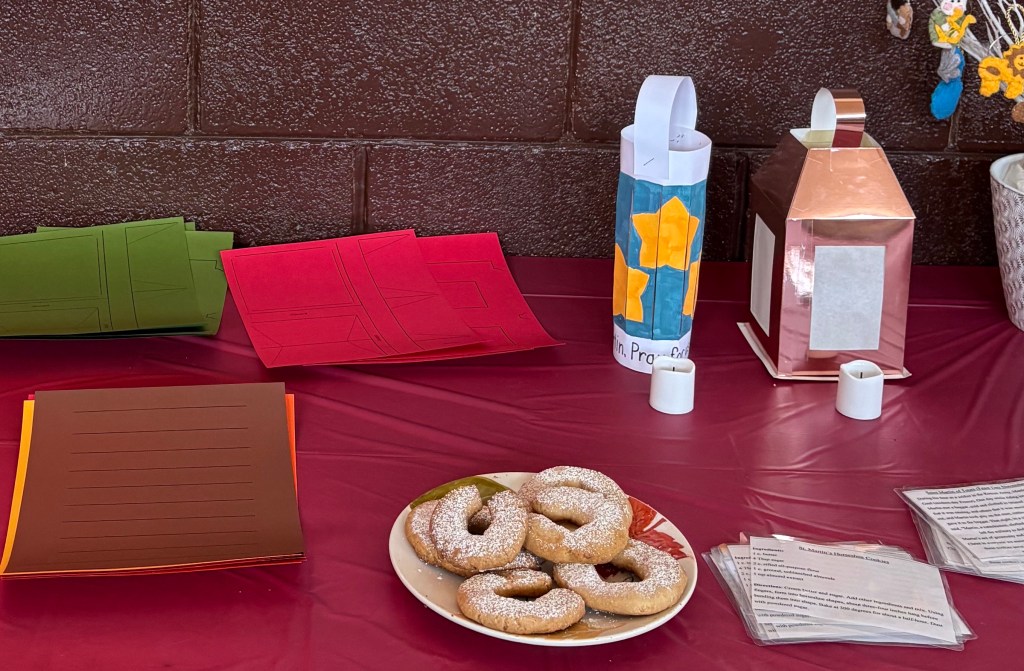
Martin is a saint with a vast number of miracles attributed to him. He became a catechumen at the age of 10, despite his parents disapproval (Christianity was a legal religion in the Roman Empire at the time), and at 15 he was required to join the Roman army, as the son of a Roman soldier. He joined the cavalry, and while serving, encountered a beggar to whom he famously gave half of his cloak. From there he went on to become a monk and a hermit, and eventually, bishop. Icons of Martin typically depict him sitting upon a horse, and dividing his cloak. (This depiction is where the origin of the St. Martin’s Horseshoe Cookie originate.)
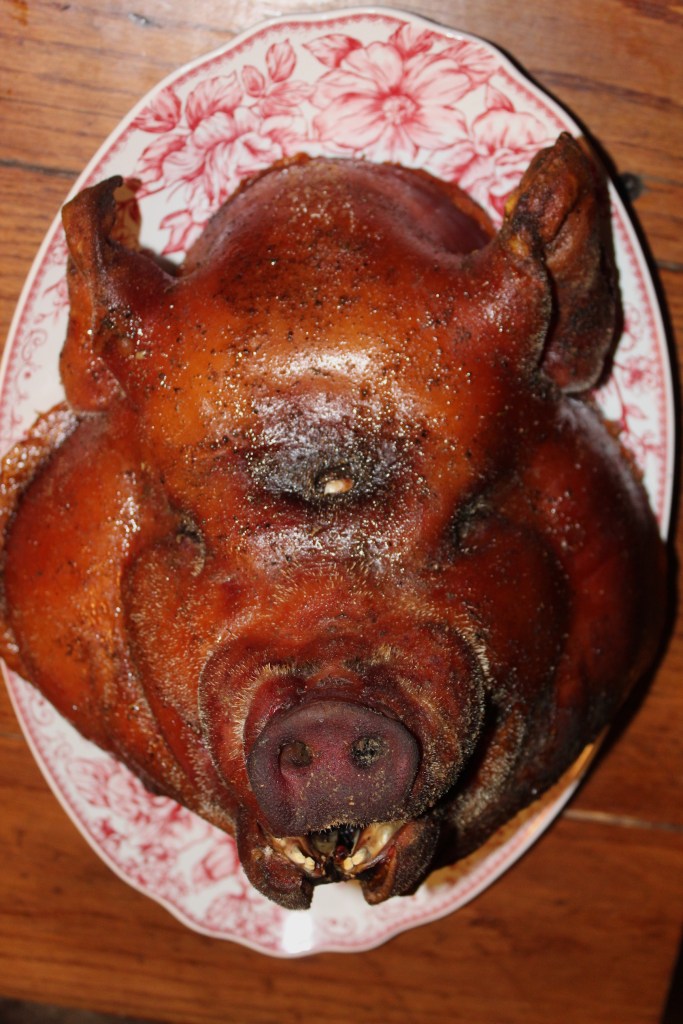
Though goose is the traditional meal, goose is not something typical in the American diet. Sometimes, it can be easy to get caught up in thinking that whatever was traditional or is traditional somewhere, ought to be how we celebrate as well. The goose may have significance, but if you are unable to eat it for one reason or another, it shouldn’t prohibit you from celebrating! We’ve observed this feast with and without goose. The first year, we had a turkey, and last year, in the absence of any poultry, I cooked a roast pig’s head and pork belly for our celebration. We have typically celebrated with a meal comprised of the various things harvested from our gardens, and enjoyed the celebration with friends. It is also customary to make lanterns to process with on the evening of this feast day, and we have at the very least, made lanterns, though not always processed. The lantern serves as a reminder of the light of Christ, and is a call to remember that we, like St. Martin, need to be that light for others.
You can find the recipes mentioned in the links below:
Horseshoe Cookies
Horseshoe Cookie Recipe Card
Roast Goose
Roast Pig’s Head
Pork Belly
You can download the PDFs for making paper lanterns below, but you can also make a super simple lantern using a paper lunch bag. You can cut out shapes, leave it in tact, or use a paper punch to make designs in it. Just be cautious if using real flame with any of these… you don’t want to start anything on fire! I use battery-operated candles. Lanterns can also be made by taking old metal cans, filling them with water, and freezing them. Then take a nail and punch a design into the can and let the ice melt.
Easy
Square
If you plan to do any hunting or butchering around this time of year:
St. Hubert
Prayer card
And if you are new to concept of liturgical living…
Liturgical Living booklet (PDF)
Liturgical Living
Did you know that Saint Martin’s feast day was at one time, the beginning of the Advent season? It has sometimes been referred to as Saint Martin’s Lent, and lasts about 40 days (44 days, to be exact, including Sundays). This can be a great way to increase your Advent observances and practice further mortifications in the time leading up the Incarnation of Our Lord!
In addition to the foods listed above, I personally enjoy making apple and pumpkin pie, mashed potatoes, corn, maple glazed carrots, and fresh bread to serve at our feast, and of course, we love having hot apple cider to go with it, all from our harvest!
Let me know your favorite way of celebrating this feast day!
Saint Martin, Pray for us!
In Christ, Danielle

Leave a Reply