Predicting the weather is no modern concept. For ages, people observed weather patterns and how they flowed with the cycle of seasons and the calendar. Though today we have satellites and radar to help track storms and the wind currents that blow them, meteorologists still rely heavily on patterns of behavior to forecast the weather in the coming hours, months, and days. Most Americans would be familiar with the weather predictions of Punxsutawney Phil on Groundhogs Day… if Phil the Groundhog sees his shadow, you can expect 6 more weeks of winter. No shadow means an early spring. But such weather predictions are not relegated solely to secular holidays. There are many predictions tied to feast days or other liturgical celebrations.
Weather predictions have long been used to help farmers make plans for the season or days ahead. After all, successful planting and harvesting rely heavily on the farmer or gardener know the right time to get to work. Rain during the growing season is typically not a problem, but at planting time or harvest, it can make or break a season if we do not finish our work before the rains come. There is never a guarantee that the weather will match an expected pattern or prediction, but a good prediction could have been “make or break” for the growing season in a time before satellites.
In the days before a yearly calendar hanging on the wall or on a phone was the norm, the passing of days, weeks, months, and years was often counted by the moon or the seasons, and people kept track of what day it was based on particular markers of time, such as feast days. They might have arranged to meet with a friend “six days after St. Isidore’s feast,” or “two days before Christmas,” rather than saying “May 21st” or “December 23rd,” because not everyone tracked the dates in that manner, but everyone knew when the next feast day was coming. Likewise, they based many of their weather predictions off of the liturgical calendar.
Because I found this rather fascinating, of course, I decided I needed to attempt to track these predictions myself! I have only just begun to track them, but I’m interested to see how accurate they are. There is one big caveat, however. Most of these predictions originated in different regions of the world, and therefore may have absolutely no correlation to the weather where I live. The only way to know is to track it!
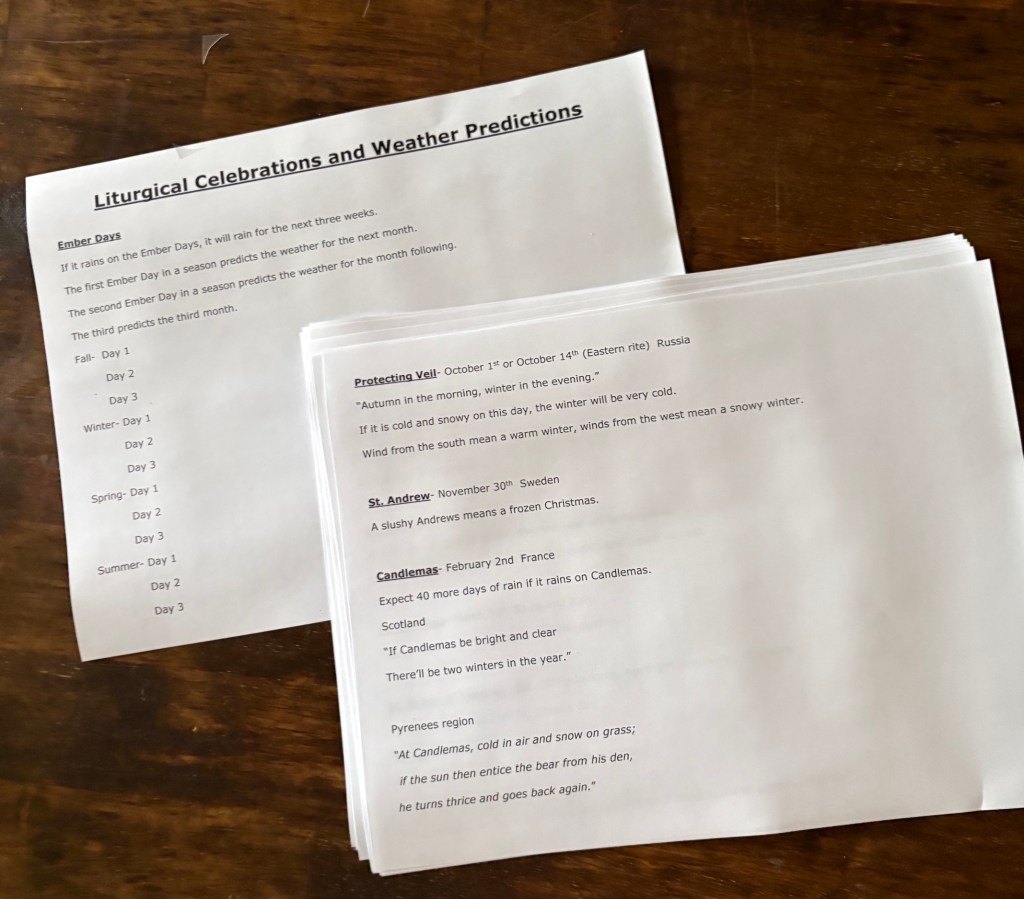
I compiled a list of predictions and organized them by date (beginning with Autumn because we’re tracking this for our current school year). I’m not entirely sure of when these all originated, but some most definitely date back to the Middle Ages. Not included on the prediction are the “Ice Saints,” which vary in name from country to country. In some countries, these are the traditional marker of the final frost dates, after which people would begin planting. (The dates are May 12, 13, and 14.) That means that planting typically takes place on or after the feast of St. Isidore the Farmer on May 15th. Two of these predictions come from the Carolinas, I believe, and would be more modern in origin, and not specifically from Catholic roots, but Christmas and Easter are our most important liturgical celebrations! So far, the only one I have tracked was the prediction for St. Tryphon’s day (February 14th), and it was accurate!
If you would like to track these predictions, too, I have included the file below, which you can download. It’s nothing fancy. If I get time, I’ll try to format it better, but it should do the job for anyone interested! If you know of any predictions that I have missed, please, let me know, and I will add them to the list!
In Christ, Danielle

Leave a comment