As the weather gradually begins to shift, around the time of the autumn equinox, the Church celebrates the autumn Ember Days, a time of prayer and penance as we thank God for this new season, the harvest it brings, and His blessing on it all, and a time for us to pray for “laborers for the harvest”- priests. Though this period of time is not as widely acknowledged as it once was, the Church still prays for these things.
The ember Days are quarterly days that roughly align with the natural seasons. Each takes place the Wednesday, Friday, and Saturday after a particular liturgical observation, with the autumnal Ember Days taking place after the feast of the Exultation of the Holy Cross on September 14th. (It was known as Holyrood or Holy Rood during the Middle Ages.) The name “Ember Days” has nothing to do with embers of a fire, but is a corruption of the Latin term, “Quatura Tempora” or “quarterly season.”
Each season has its own specific harvest for which we pray, and in autumn, we pray for the harvest of grapes. Grapes are a central element of our Eucharistic banquets, along with wheat, as they become the Body and Blood of Christ. Did you know that the wine used for liturgical use cannot additives? The grapes must be unspoiled, as well. Liturgical wine can be white, red, or pink, and the color of each has meaning- white for the purity of Christ, red for blood, and rose for Christ’s humanity and divinity.
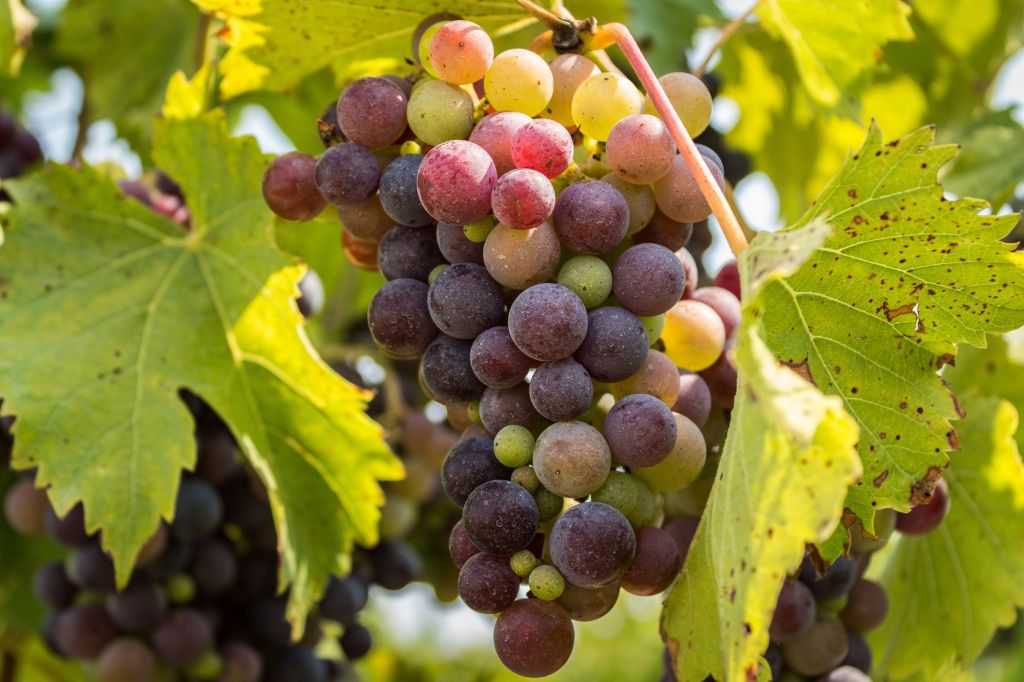
Liturgical wine was once commonly produced on a relatively local level, with monasteries and convents oftentimes being responsible for its production for their own community’s use and also for the surrounding parishes. Though when we speak of the Blood of Christ when we refer to what the chalice holds at consecration, it is considered both Body and Blood, and likewise for the Host.
Though wine is a central element of our Eucharistic celebrations, it also has a long tradition of being used in shared meals, celebrations, and in the company of others. Wine, in a sense, is symbolic of communion, but of course, once it is transubstantiated during the Eucharistic banquet, it becomes Communion.
Grapes, of course, are enjoyable in their own right, and homesteaders grow them for use in homemade wine, juices, jellies, and for fresh-eating. I’ve even made grape pie before! No matter how we use our grapes, we can still ask God for His blessing!
A Prayer for the Autumn Ember Days
Bless, O Lord, these new fruits of the vine which Thou hast brought to maturity by the dew of heaven, by plentiful rains, and by tranquil and favorable weather. Thou hast given us this fruit for our use that we may receive it with thanks in the name of our Lord Jesus Christ, who liveth and reigneth with Thee in the unity of the Holy Spirit, world without end. Amen.
To learn more about the Ember Days, you can check out these posts:
And if you are interested, the Church has other traditional times for praying for grapes and grapevines: the Feast of the Transfiguration, Rogation Days, and the feast of St. Tryphon.
In Christ, Danielle

Leave a comment