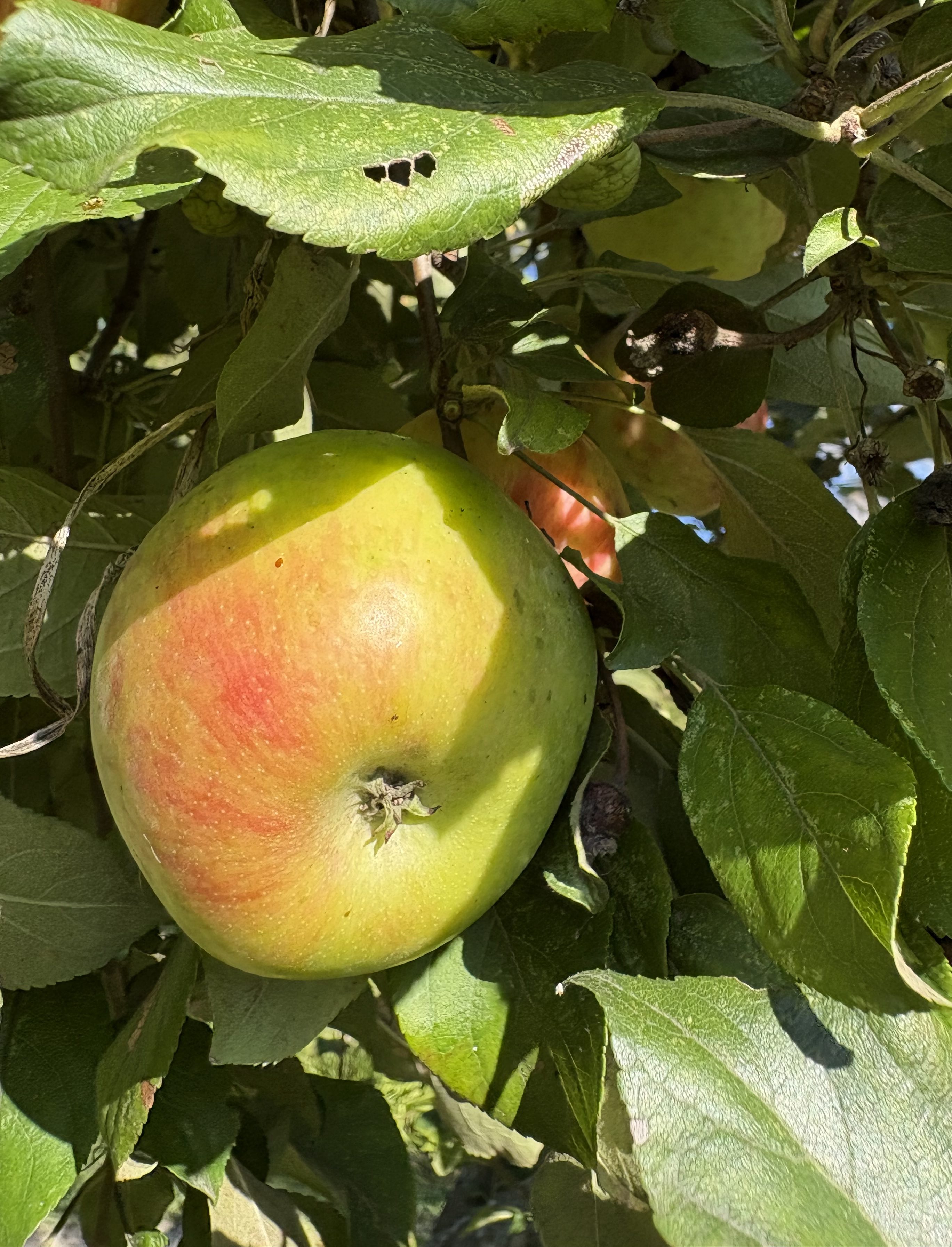
For many, the idea of the forbidden fruit in the Garden of Eden is synonymous with the apple. Perhaps the reason for this is because the apple tree is the most common fruit tree in the world. (Jewish tradition holds that the fruit is a fruit from the citron family called the etrog, and some believe it to be the pomegranate.) Whatever the case may actually be, the apple tree is a fruit tree many homesteaders across the globe would be capable of growing to produce for an abundant source of food that requires relatively low input for a good crop. The apple’s association with faith traditions runs deep, and in the Jewish tradition, on Rosh Hashanah (the Jewish new year, which is celebrated in the autumn), they eat apples dipped in honey.
There is no shortage of stories that connect our faith to this prolific fruit tree! And if you take the time to do research on apples at all, you will find that there is an abundance of apples named for saints, either directly or indirectly. Some are named after the city in which they originate, which is named for a saint, some are named for the very saints who cultivated the particular variety, and others are named in honor of a beloved saint. Throughout my own searching for saints for apples and apple orchards, I came across mention of Allantide and the Allan apple, and eventually across a story of one saint (I can no longer find the story), who gifted an Allan apple. Allantide is the feast of St. Allan of Quimper. The feast shares certain traditions with All Hallows Eve, and they do fall on the same date. The association of St. Allan with the apple is also unclear, but is likely due to the fact that his feast falls during the time when the harvest of apples is still taking place, and apples are in abundance. So frequent are these types of stories… a connection that is vague at best, but likely has to do with the correlation between the natural seasons and that of the liturgical calendar.
If you are seeking a patron for your own apple orchard, I have a few suggestions. I will start with the least applicable, and end with the most!
A quick internet search for the patron saint of apple orchards is St. Charles Borromeo. The reason, however, is completely unclear. Nonetheless, St. Charles is a wonderful saint (as they all are), and is well known for his work in the Counter-Reformation. He did great work to establish better education for men seeking a life in Holy Orders, founding seminaries and more to support these men.
If you research “patron saint of apples,” it is likely that St. Dorothy will be the first result. But there are three saints who have stories in their hagiography containing three apples from paradise. St. Euphrosynos, St. Irene, and St. Dorothy. St. Euphrosynos’ life (also known as St. Euphrosynos the Cook) is primarily venerated as a saint within the Orthodox tradition (though he would have been venerated as such prior to the East-West Scism). His feast is September 11th, the perfect time for a blessing of the apple harvest. His icon depicts him holding a branch with three apples on it. The short version of the story is that Euphrosynos was a humble monk in a monastery, working as the cook. One night, a priest in the monastery was praying, and in a dream, he went to Paradise. While there, he encountered the cook, whom he recognized, and asked what he was doing there. Euphrosyos replied that he was in charge of all that the priest saw. The priest asked if he could have anything from the garden to which the humble cook replied, “Yes.” The priest asked for some apples, which the cook gave to him. When the priest awoke, he found that the apples, fragrant with the smell of Paradise, were wrapped in his garment. He sought out Euphrosynos and asked where he had been the night before, and Euphosynos responded, “I was where you were.”
St. Irene Chrysovalantou (feast day July 28th) was originally to be married to Emperor Michael III, son of Emperess Theodora, but as she was traveling to Constantinople for the marriage, he was already married to another woman. On the way to the city, however, she visited a hermit who told her she needed to travel to Chryovalantou where she was told she was needed. There she entered the monastery and would eventually become Abbess. As the Abbess, on the feast of St. Basil, she had a visit from a sailor who came bearing a gift of three apples and a story to accompany them. As he was sailing away from the island of Patmos, an old man beckoned to him, asking him to stop. The old man then walked across the water to the sailor and boarded the boat. There he gave the sailor six apples from beneath his cloak. Three, he said, were for the patriarch, “Tell him that the Almighty sends them to him from His beloved disciple, John.” The other three were to be given to the Abbess of Chrysovalantou with the message from St. John, “Eat these and all that your beautiful soul desires will be granted you because this gift comes to you from John in Paradise.” St. Irene prayed, asking God to help her know what to do with the apples. For forty days, she lived solely off of one small bite of the first apple each day. The second apple, she shared with the nuns of the monastery on Holy Thursday. And the third, she ate in her final days as sustenance for her final journey, at the age of 102! St. Irene’s feast day comes with a blessing for apples.
St. Dorothy was a martyr for the faith. She was ordered to be tortured and then executed, having reconverted two sisters who apostatized and for standing firmly for her own Christian faith. The torture included hoisting her to a rack, burning her on both sides and beating her on her face. Her execution was to be a beheading by sword. Prior to the beheading, an officer of the governor, Theophilus, mocked her saying, “Send me some roses and apples from this Paradise of your Spouse!” She agreed, and before her beheading, prayed. A beautiful child immediately approached her holding three apples and three roses in a napkin, and she asked the child to bring them to Theophilus, and then she was swiftly executed. Theophilus was greatly surprised when the child approached and gave him the roses and apples, as it was February and not the time for fresh apples or roses. He was converted on the spot and also became a martyr for the faith. Her feast, on February 6th is a traditional time for the blessing of apple trees. It fittingly falls around the time that apple trees are being pruned in orchards.
The final saint I would like to introduce to you does not have the same miraculous story of apples from Paradise (which are all wonderful and legitimate reasons to choose one of these saints for patronage over your own fruit trees or orchards). He and his companion, St. Samson, are known for planting an apple orchard. St. Teilo of Llandaff was a 6th century monk and bishop. His feast day is February 9th, and he is often depicted riding upon a stag. The orchard these saintly men planted during the time of the yellow plague was nearly 3 miles long, and it would have provided food and hope in a time when the countryside would have been recovering from the devastating effects of the plague. In England, February would have been a suitable time for both planting and grafting, though where we live in Wisconsin, the ground is still frozen solid, and grafting usually happens a bit later. We do, however prune our fruit trees at that time of year.
Perhaps you will become friends with all of these saints, but no matter who you befriend, know that you have good company in your orchards! (For the blessing of fruit trees, you can check out this post.)
Happy picking!
In Christ, Danielle


Leave a comment