
Today when most people think of Easter baskets, they picture baskets filled with toys and loaded with candy and brightly colored plastic eggs, delivered by a mythical rabbit, but the tradition of the Easter basket has not always looked like that. Common to this day throughout Eastern Europe is a tradition of filling baskets with items that each symbolize something important. These baskets are either brought to the Easter vigil or to Mass on Easter morning, and receives a priestly blessing. Every item within it symbolizes something and is meant to be breakfast for Easter morning.
A good friend of our family first introduced us to this tradition several years back, when he arrived at Mass on Easter morning with his Polish Easter Basket, known as “Swieconka.” When I began researching for the book I am writing, I reached out to family and friends to see if they knew of any Catholic traditions that may pertain to an agrarian life, and a relative said that in Hungary, this same type of basket blessing is common. The tradition itself appears to date back to the 14th century.

Eggs –
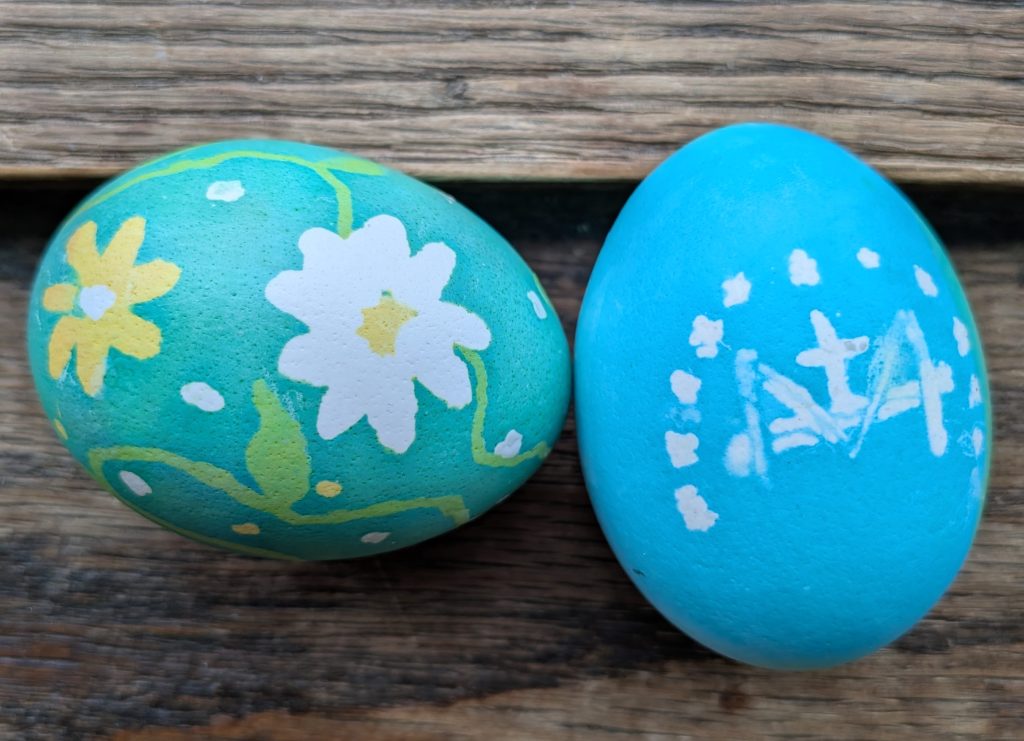
These symbolize Christ’s resurrection and new life. Often, these are “pisanki” eggs, hard-boiled and decorated using a process of waxing and dying. Red eggs are particularly common in some places.
Bread –
Represents Jesus as the Bread of Life. This might be an entire loaf or just a slice of bread. It reminds us how God sustains us throughout the year and the blessings we receive.
Lamb figure (often made of butter) –
Christ as the Lamb of God, and his victory over death. Sometimes it is shaped as a cross, and reminds us that we should emulate Christ’s goodness. (The lamb-shape is typically achieved with the use of a mold.)
Salt –
Symbolizes preservation and purification. It is a reminder that we are to be the “salt of the earth,” and the importance of truth and honesty.
Horseradish –
Represents the bitterness of Christ’s suffering. A reminder of the suffering and bitterness of life, it reminds us of the need for spiritual and physical strength.
Ham or Sausage –
Symbolizes the end of Lent and marks our celebration of the abundance and Joy of Christ’s resurrection.
Sweet Breads or Cake-
They symbolize celebration and joy after the Lenten fast, it represents the sweetness and joy of life, and shows the talents and skills of the baker.
Cheese-
A symbol of moderation in all things that Christians should have.
The Basket-
The basket itself is decorated with greens such as boxwood or pussywillow, signs of spring and renewal. It is typically lined with a white, linen cloth as a symbol of purity, and the food may be covered with an embroidered napkin or handmade lace to represent the shroud which covered Christ at his burial. Additional decorations, such as ribbons may be used to decorate the basket. The basket is prepared with reverence by families to honor Christ, and in expectation of the promise of Easter.
The Blessing-
There are multiple ways in which the baskets are presented for blessing. In some parishes, baskets are place on a long table at the front of the church or at the foot of the altar, or are brought forward in procession, much like a Communion line. In other places, the community gathers outside the church in a park, a square, or a parking lot, all lined up with baskets placed at their feet to receive the Easter blessing, and the community can admire each others baskets. A priest or deacon blesses the baskets with a prayer written specifically for eggs, cakes, meats, and breads. In some rural places, priests still visit homes where the blessing is done.
In Bochnia, Poland, the local and visiting faithful visit the chapel of St. Kinga for this yearly blessing. The chapel is carved into an old salt mine that is over 200 meters underground.
A quick perusal of the typical items included in these Easter baskets readily reveals how a homesteader may find extra joy in preparing for such a beautiful tradition. Eggs, sausage, bread, cheese, and even the basket itself… all of the items have the potential to be produced on the homestead, and when these items are produced for the sake of such a tradition, they bring about a much more devotional nature to our work with the ability to point us back to God.
If this is a tradition which you partake in, I’d love to know if there’s anything I’ve missed!
In Christ,
Danielle

Leave a Reply