A few years ago, some friends of ours asked if we would raise a pig and help them to butcher it for a pig roast. The idea was that we would raise and help butcher, they would host and cook, and we’d both invite family and friends to share in a pot luck meal, with the roasted pig as the main dish. Though I don’t know if we’ll continue to provide a pig (they’re interested in raising their own), they do hope to keep the pig roast going for years to come. Whether we provide a pig or not, the community pig roast has proved to be an amazing experience. Both years, some of our friends from the parish were invited, as well as our past and current pastor, and it was a true pleasure to get to visit with some of these wonderful people outside the walls of our church.
Today, we suffer as a society from a lack of true community, and this is even more true for many Christians and many homesteaders. For the Christian, we try to live out our faith in the secular world, often times working or attending school with people who do not share our morals, values, or beliefs. Many of us never spend time building our faith with others from our church community or even with friends or family. Faith, we have been told, is personal, and therefore we believe that it should not be shared. True, faith should be personal. It is deeply personal. And yet, our faith is not lived in a bubble. Our faith comes to us through community, handed down from generation after generation for centuries of believers. We are part of the Body of Christ, and innately and intimately interconnected. When we try to live our faith in a bubble, we will become complacent and struggle to grow, and unfortunately, it can even disappear. We need support and encouragement from others who share in our beliefs and struggles.
Homesteading is not much different. A successful homestead is one that is built around family and community. Not all homesteaders have family, it’s true, but they should all have community. For many today, since this is a “new” adventure, we are left to find our own community. Neighbors might be a good starting place, but that’s not always the best fit. We need mentors and friends. Not only, that, but we don’t ever truly do anything independently. When we plant potatoes, we follow methods of others who have come before us. When we use a shovel, we rely on somebody else’s work. Every time we set foot in a store, every time we pay a bill, we are interacting with the world around us, and each of these facets form a part of a community, though it might not feel like it. All the better, then, if we are able to curate meaningful relationships with others who are a part of this life. For us, that includes the neighbor who gives us their horse manure, the family that runs the local feed mill, the man who stops by to buy our random stuff, the friend who taught us about inoculating logs with mushroom spores, and many other relationships we’ve built over the years.
Neither community (faith or homesteading) came about without some effort on our part. True, our parish provided a starting point for us for both of these facets of our life, but we had to engage. So often, people are unwilling to engage, to give their time, to be “inconvenienced.” Sometimes we have to push ourselves, stretch ourselves in the service of others. It can be hard, and we need to be mindful of resentment that can build if we overdo it, but you never know what you’ll discover when you invest love in other people.
At this past pig roast, we invited a couple that aren’t members of our parish, but that show up quite frequently and we’ve become friendly with. We talked a bit, but they spent a good deal of time mingling with other people, and I found out afterwards just how much they appreciated the invitation. Several years ago, we raised multiple pigs for family and friends, and we had a butchering weekend where everyone came to help out, plus a few people who were interested in learning about pig butchering. It was an exhausting weekend, but the community building was incredible, and others learned so much from the experience (so did we)!
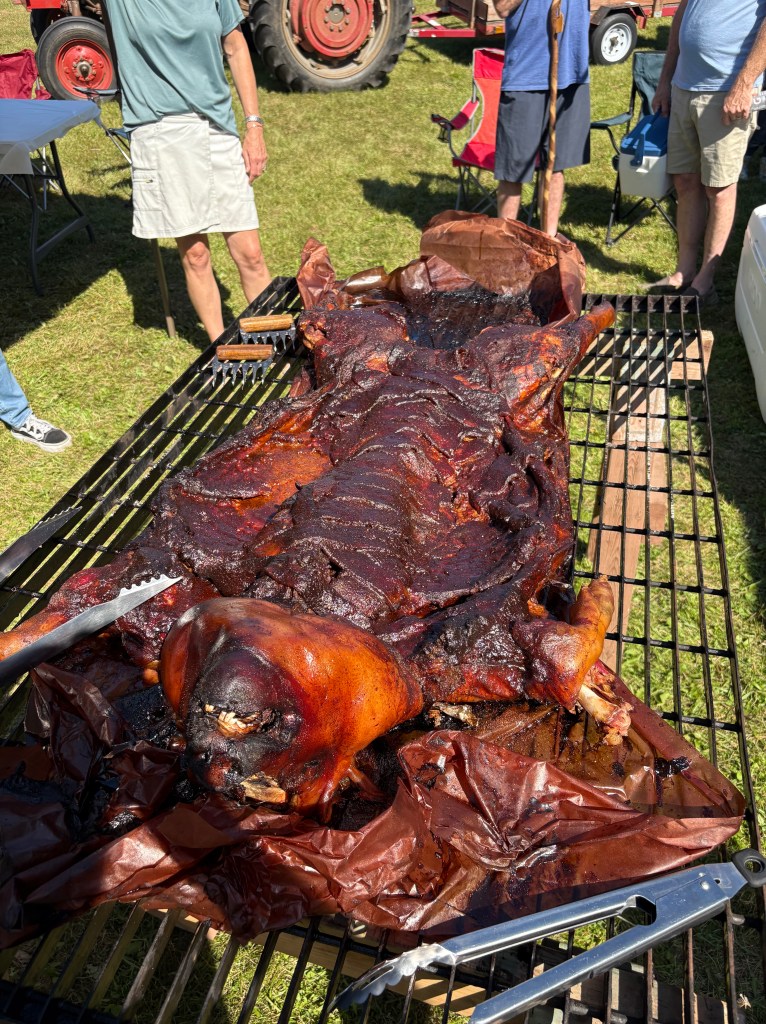
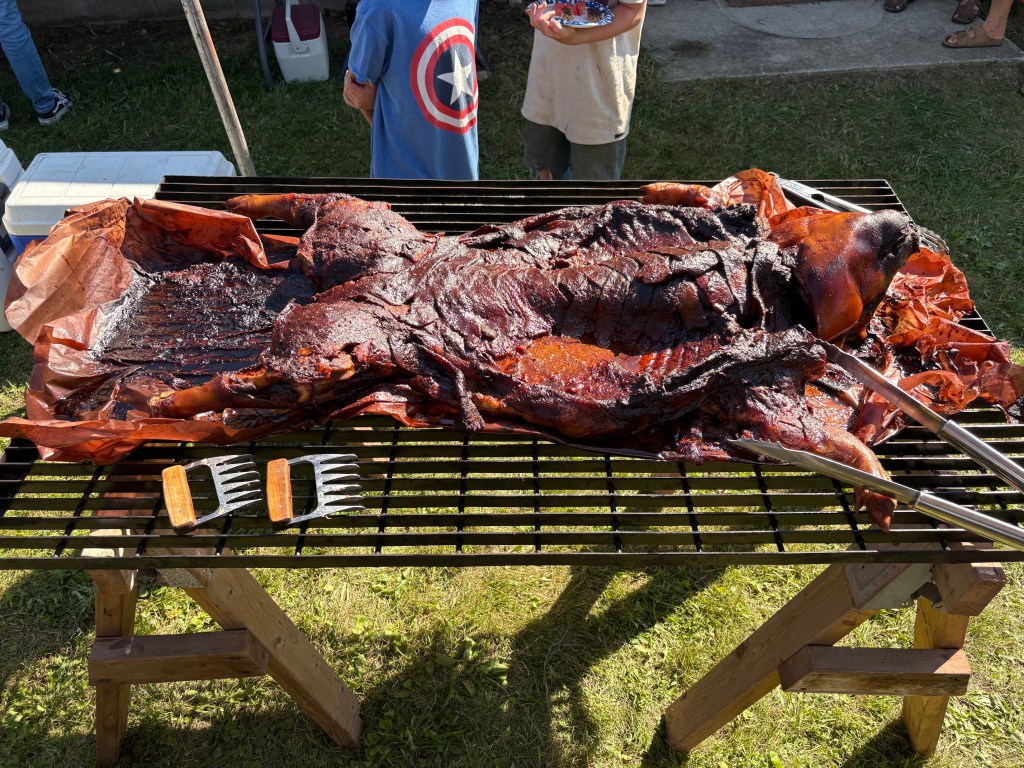
If you’re looking for ways to build community, I’d encourage you to consider doing something like a pig roast for family, friends, and neighbors, or even for those in your parish. The raising, butchering, and cooking could be done on your own, but it is a great way to get started building community if you find another to take on some of the tasks with you! For our pig, we bought a “weaner” (a piglet that has been weaned from its mother), and raised it for 4-5 months. (Pigs are social animals, and you should raise at least 2 if you don’t want to be dealing with escaping pigs!) The pig was slaughtered a few of days before the pig roast, gutted, and scraped, then left to chill in the neighbor’s walk-in cooler for a couple of days. The pig was cooked (barbequed) in our friends’ smoker for about 24 hours. Everyone who came brought chairs or blankets, beverages and a dish to pass, and our hosts provided coolers with ice, tables, plenty of water, and all of the disposable items.
As for when to host a pig roast, our friends chose to do it Labor Day weekend. We don’t plan to ever host our own pig roast, but if we were to do that, we’d probably choose a Catholic feast day to do it. Regardless of when it’s hosted, the important thing is that we learn to build real relationships, in person, with the people who surround us. God created us for community! When my family began homesteading, we didn’t know where to go for help in our endeavors, but when we started to attend our rural parish, it didn’t take long for us to discover that many of the people who shared the pews with us had experience with things like tapping trees, raising bees, or butchering animals. We’ve built a lot of wonderful relationships over the years, but it took putting ourselves out there in order to find it.
While we aren’t the ones who cooked the pig, if you have any questions about raising the pigs, butchering or cooking, let me know, and I’ll do the best I can to answer them!
In Christ,
Danielle

Leave a Reply