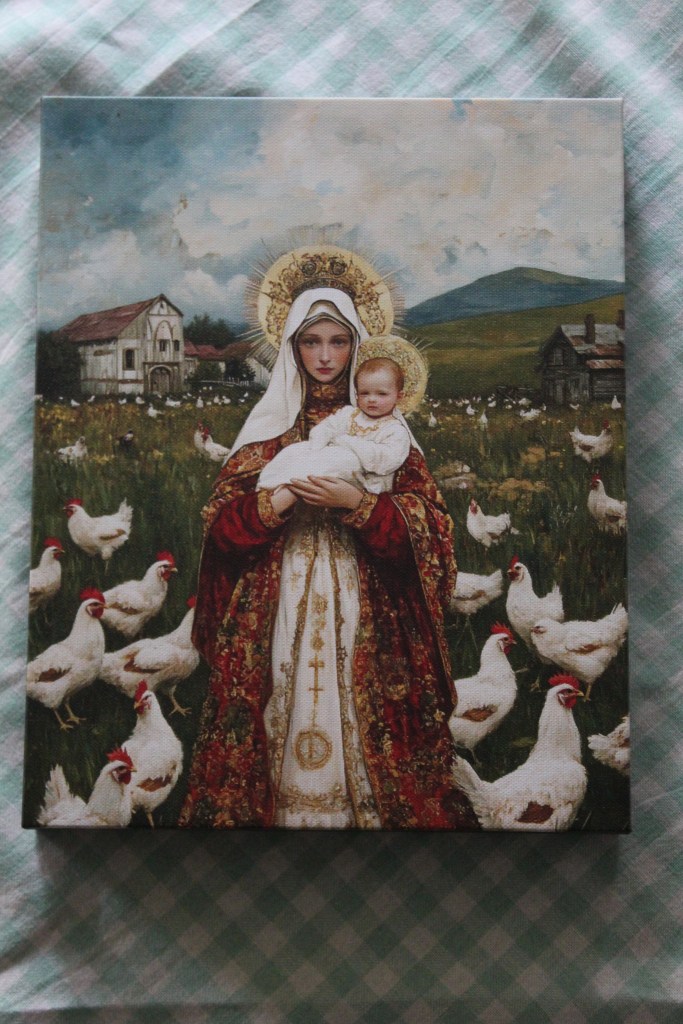
Each year, on the Octave of Easter, there is a celebration of Our Lady of the Hens. This celebration predates the more well-known Divine Mercy Sunday, but has never been widely observed in the Church. About a year ago, I was scrolling through my Instagram feed, and suddenly stopped short. Here was a beautiful image of the Virgin Mary holding the infant Jesus. In the background was a barn, and there were chickens all around her. The caption under the image said it was “Our Lady of the Hens” and gave a brief description. I fell in love with the image and decided to order it, especially considering the story of this Marian encounter. (It wasn’t until after I ordered a print that I realize the picture was created using AI. The seller works carefully with AI to create the images they curate to sell. The chickens primarily look like roosters, though I’ve had hens and roosters over the years that were a bit non-descript, so it didn’t really bother me. The picture is still beautiful, though I’d love to see it done by human hands, and I’m grateful that it introduced me to this title for Mary!
The story begins in a parish in Tramonti in Italy, where a wooden panel of The Virgin of Carmel resided. One night, the Virgin Mary appeared to the church sacristan in a dream. She asked him to speak to the priest and tell him to repair the church which was beginning to fall apart, or she would go away to a town where “even the hens” would love her. The sacristan did as he was bid, but the priest failed to take seriously the warning. One day, a storm came through and somehow the wooden panel was washed away, carried downstream in the mud, where it was eventually deposited in Pagani.
On the Octave of Easter, sometime during the 16th century, the panel was discover. It was found in the dirt as chickens were scratching around. The image was housed in the parish of San Felice, where one night in 1609, a crippled man sleeping in the vestibule of the church (where the image was stored) fell asleep. In his dream, the Madonna spoke to him and told him to get up and be rid of his crutches… he was healed. This was the first of 8 miracles that occurred in regards to the image over the course of the next year. It was decided that a “more worthy” church would be built to house the image.
Today, the original panel is either no longer in existence or no longer on display. The original painting has been replaced by a replica on canvas, and the shrine that is where this feast is primarily observed also has a statue of the same depiction of Mother and Child.
The feast is still celebrated today with a festival lasting 4 days. Sources indicate that it begins on Easter Friday, and continues through Easter Monday, with the feast day itself landing on the Sunday after Easter. It is celebrated with services and Mass, processions, dances, and even fireworks. Traditional Easter foods of Italy are served, including tagliolini and casatiello.
What really drew me to the story of this Marian apparition is that Mary, though she is Queen of Heaven, was not too important to be found among the chickens, and she brings her Son with her. Farmyards are not places where nobility are typically found, and yet it was in a humble stable that Mary gave birth to Jesus. There was no demand for better quarters. God was not too great to be found among the animals. When the parish priest neglected to take Mary’s words seriously about the care for this home for Jesus, she was willing to go back to be among the animals with her Son again. Too often, especially within the last half-century in America, the farm is something that has been mocked and belittled, just a smelly, dirty place where nobody important could possibly reside, and only the uneducated would choose to live.
The title “Our Lady of the Hens” reminds us that our homesteads are places where Christ can be found. As I’ve shared before, the homestead can be a place of evangelization. For all of the negativity that exists towards this way of living, the more I learn about living off the land, and the more exchanges I have had in regard to this way of living, I have found that it is perhaps, the ideal place for evangelization. The homestead itself evangelizes us, brings us to a deeper and deeper appreciation of our faith. It provides context for understanding Scripture, which we can in turn, share with others. This is all the more important today, when the world is so deeply connected from the land that God uses to teach us.
In Christ,
Danielle
 The Liturgical Homestead
Leave a comment