
When I began my research into different liturgical customs that pertained to the homestead, one that was shared with me was the red eggs given at Easter. What was initially shared with me was that in some countries, red eggs are handed out at Easter to people as a sign of affection or romantic interest. I made note of the tradition but initially didn’t look into. Not too long after, we attended Pascha at the local Monastery, and I noticed red eggs on all of the tables at the feast after Divine Liturgy. Now I was really curious and began to do my research, which in turn, led me to explore “pisanki,” a form of egg decorating done for Easter throughout parts of Europe, though it bears other names, such as “himestojas.”
Growing up, my family enjoyed decorating Easter eggs. I remember using rubber bands to create patterns on the eggs while dying them, and drawing pictures on the eggs with crayon. I didn’t have much exposure to elaborately decorated eggs, though I’d see them illustrated in books from time to time. I always wondered why I couldn’t get my eggs to look so amazing. When I tried my hand at painting goose eggs, I had the sudden realization that many of the eggs I’d seen would have been hand-painted. At this point, I’d seen images of pisanki, and even read about how they were made, but to be honest, it still wasn’t registering with me how this technique was done, and it wouldn’t be until months later that I started to run across videos of the technique on my Instagram feed. I was mesmerized! The more I explored the topic, the more I realized that my “American” version of egg decorating growing up, while not bad, lacked a depth of meaning. Mind you, I did write the words “Alleluia” and “Christ is Risen,” attempted to draw a tomb or 3 crosses, as an acknowledgement of the purpose of Easter, but the Easter bunny existed to me in those earliest years, and so my understanding of Easter was a bit coopted by this tradition.
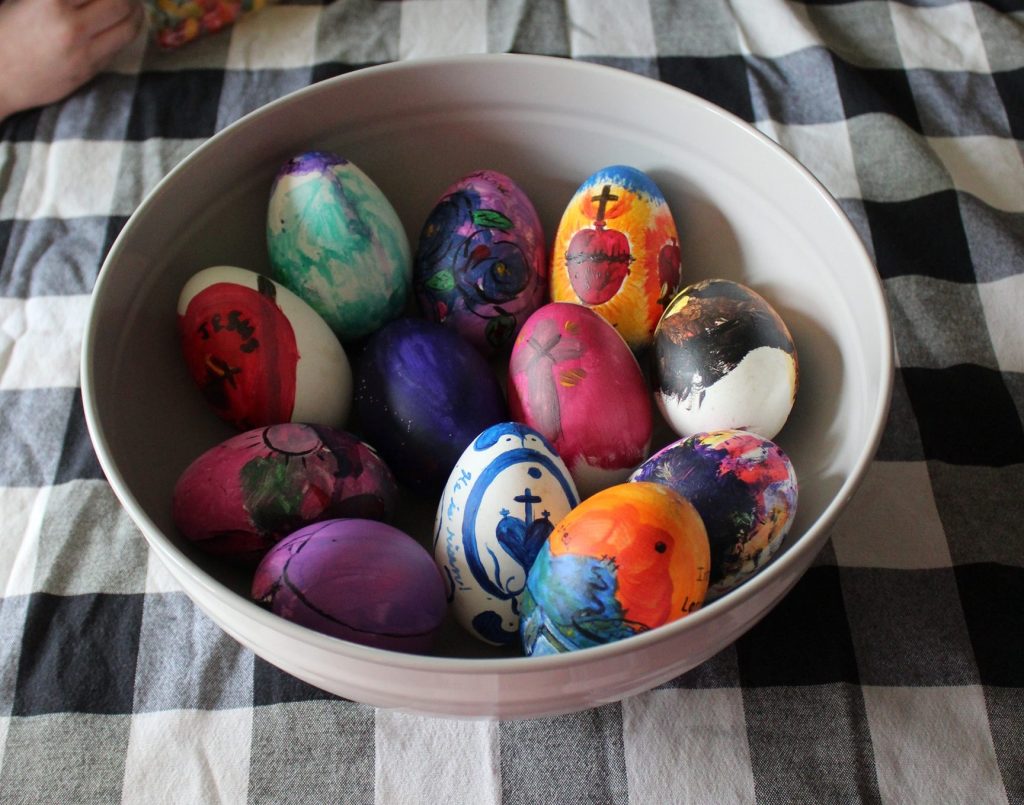
When I was initially introduced to the idea of red eggs, I wasn’t sure what to think. Why was red so important, especially if these eggs were handed out as signs of affection? Well, traditions can take on new meaning and grow with time, and the giving of the red egg as a sign of potential romantic interest was something that came along later in time. The tradition of the red egg, I think is much more fascinating!
Though I’ve done some reading on Mary Magdalene and admire this saintly woman, I had never seen an icon of her holding a red egg, and yet, it is a very common icon depiction. (To be fair, it has only been in the past couple of years that I’ve really been exposed in a significant way to any icons.) Most depictions of her have her holding a jar of oil, much like the one hanging on our living room wall (though technically, the oil jar is on the ground next to her in that painting). Known as the “Apostle to the Apostles,” because she was at the tomb on Easter morning and asked to tell the news to the apostles. Though accounts of her life are difficult to piece together with any certainty, as with the Apostles, we do have traditions that come down to us throughout history to fill the gaps of what life may have been like for her in the years after Jesus ascended into heaven.
One story in particular is where the tradition of the red egg originates. Mary went to Rome to preach, and gained an audience with Emperor Tiberius. She joyfully proclaimed to him, “Christ is risen!” While sharing the Good News with the Emperor, she held an ordinary egg and explained how though an egg appears seemingly lifeless, from it, new life can emerge as a chick hatches, likening it to the resurrection of Christ on Easter morning. The emperor, unbelieving, said that Jesus could no more come from the tomb than the egg in her hand was red. At this, the egg turned red! From this, the tradition of giving and decorating eggs at Easter developed.
Now, to me, that’s a much better story than “the Easter bunny” delivers them! The red egg not only reminds us of the miracle of the resurrection, but of Mary Magdelene’s bold faith. The red has come to symbolize the Blood of Christ, His victory over death, new life, and renewal. The egg itself holds meaning for us as Christians, as we can see from the story above. The shell represents the sealed tomb, and cracking the egg represents Jesus’ resurrection.
The methods of decorating have probably varied throughout time, and most certainly varied from place to place, but most include the use of symbols that represent something in our faith life. One such symbol would be a form of cross for Christ, another is the triangle to represent the Trinity. Others are lines that have no beginning or end, representing the eternal nature of God.
There are multiple ways to create the designs of pisanki. One such is the scratch method, in which an egg is dyed red or some other color, and the design is scratched or etched in using some sharp object, such as a razor blade. The method I found particularly fascinating is the wax-resist method. For this method, the eggs are either blown or boiled, and the egg is decorated with wax wherever the color is to remain the same. Using a sort of stylus called a “kistka,” melted wax is used to draw designs on the egg, and then the egg is dyed. This can be done once or over an over again. The addition of each new layer of wax covers the new color on the egg.
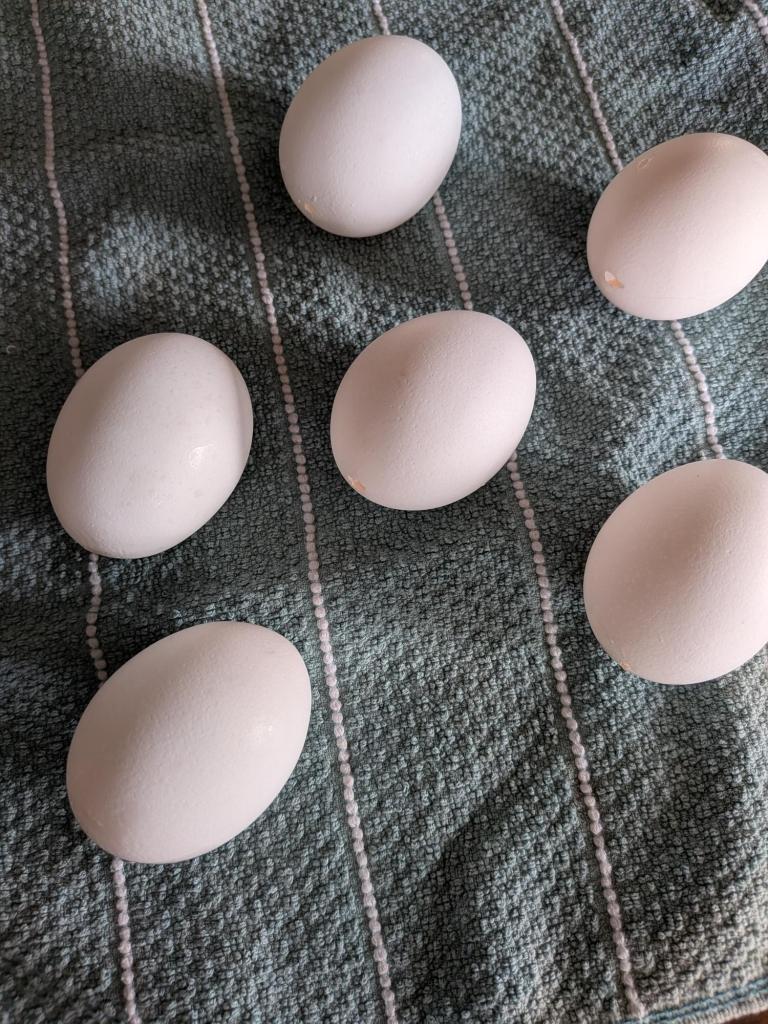
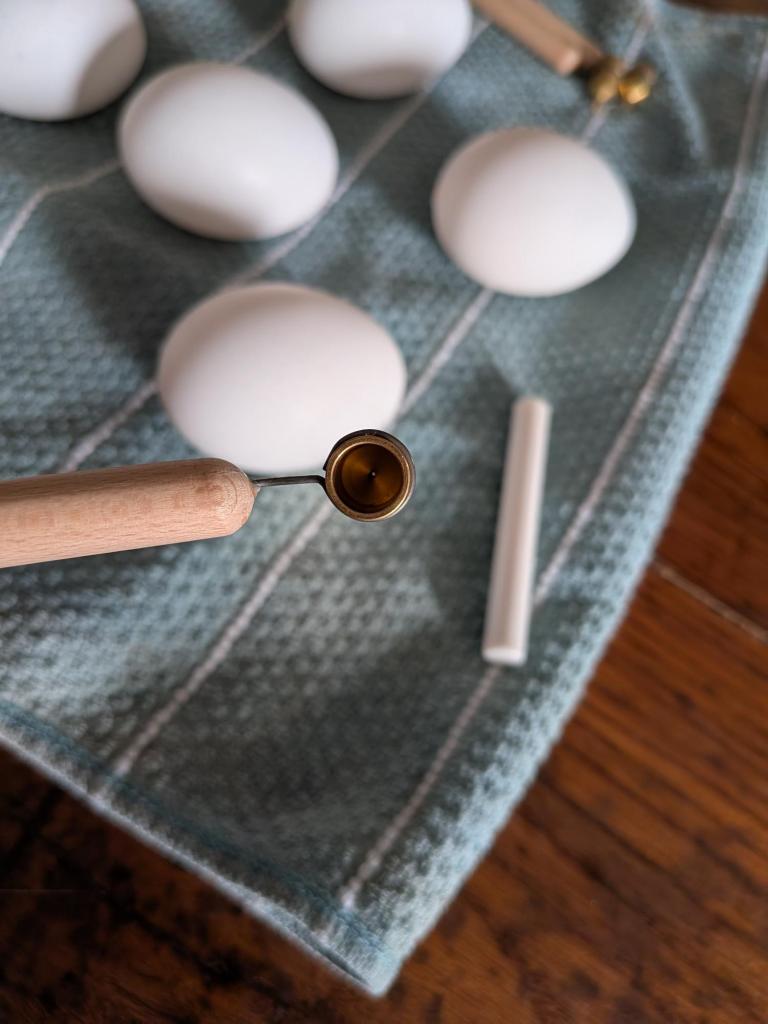
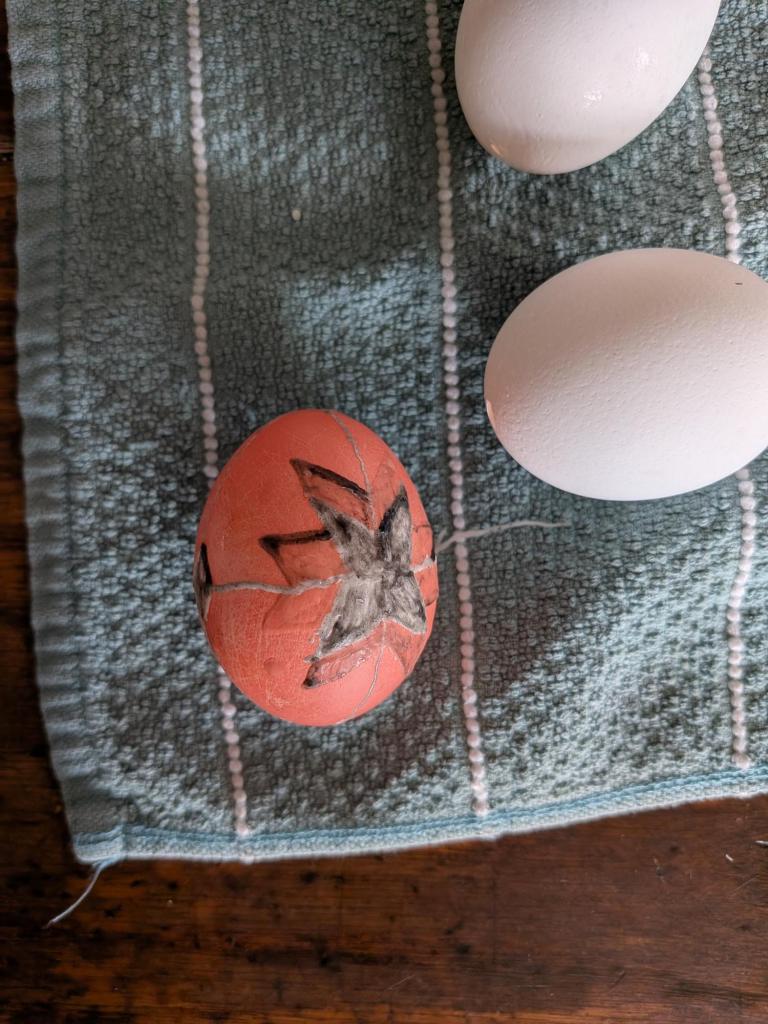
For example, if I want white areas on my egg, those are covered with wax first, and then the egg is dipped in the color I want next, potentially yellow or orange. More wax is added over the yellow, the egg is dyed again… and so on and so forth. This can be done progressively in the same color to deepen the shade of the color. For example on my first real attempt at this, I used red dye and left it in the dye longer and longer. On the final dip, I added a bit of black to the dye to deepen the color even further. If multiple layers are done, the final color of the egg dye is either naturally already quite dark, or it is dipped in black dye on the final dipping before the wax is removed. Then the wax is melted off (by holding it carefully over a flame) and wiped clean. Though I have seen many elaborate colorings, many of the eggs I have seen are simply white or brown eggs with a single layer of wax added to the egg, and then dyed red.
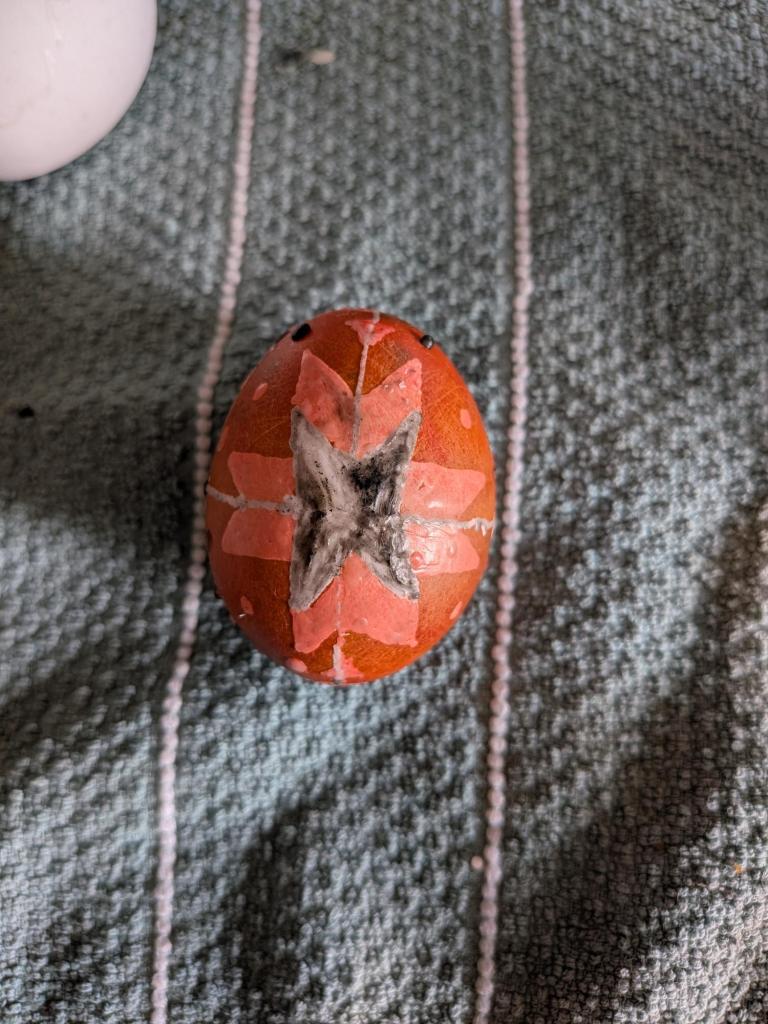
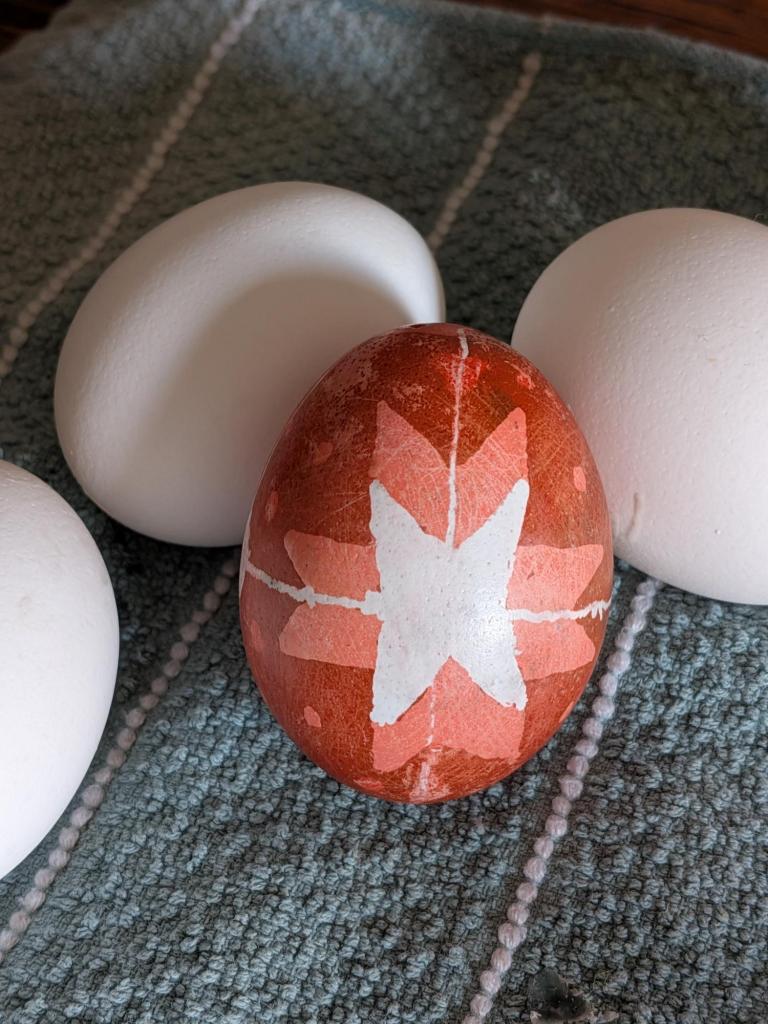

My first attempts at this are not the most beautiful. There’s a bit of a learning curve to getting the stylus of the kistka heated just right. Too hot, and the wax will pool off the tip when it touches the egg, rather than dragging a line. Too cool, and it won’t draw, or the lines will be too thin or not adhere well. The stylus was loose in the loop that holds it to the handle of the tool (I wasn’t able to tighten it), and so I had to figure out how to secure it so it would remain steady, otherwise the tip wobbled and made wonky lines. I used my finger nail to scrape the wax off, but you do need to be careful scraping. Too hard, and you can scratch off other layers. Too much dye will start to removed dye from the egg, so you might be limited in how many colors you can end up doing. If you are melting any remaining wax off the eggs, the flame can leave a black mark on the egg that won’t wash off if you hold the egg too close to the flame or over it for too long. Heat it for short bursts, and wipe immediately with a paper towel or a cloth. I feel that future endeavors will be much more successful as I adjust to the process.
Today, many different types of dye can be used for the process, but they would have typically been made with natural materials. Onion skins are supposed to produce a brown/red (depending on the color of the skins), beets produce pink, turmeric produces yellow… There are many different possibilities! Though vinegar is typically added to the dyes to help them adhere better to the skins, it can be helpful to rinse the eggs with vinegar before dying to achieve more even coloring. The bloom on the egg can wash off in the boiling process, which leaves a bit of a film in the water, and as eggs get pulled out, it can get left behind on the shell, which may create patchy coloring.
Whether your chickens lay white eggs or brown, they can be dyed! (I’ve never tried dying the blue or green eggs that we’ve had in the past, as I love their natural colors.) Today, we have chickens that lay brown eggs, but since we’re still waiting for them to lay enough for regular daily use, I resorted to purchasing white eggs from the store for decorating.
If you do enough reading on this method of egg decorating, you are bound to come across information about how eggs were decorated in Slavic countries, predating the introduction of Christianity into the region. I don’t doubt this is true, but it is not simply a tradition that Christians baptized from pagans. Though the exact methods may have varied throughout time, egg decorating seems to pretty clearly have independent roots in early Christianity. That God could use a practice like egg-decorating to help unify people should not surprise us at all, I think!
That the chicken, being such a prominent feature of most homesteads, would provide us with such an unassuming object as the egg, and yet hold such meaning, is just one more proof that this way of living is meant to direct us to our Creator!
In Christ,
Danielle
P.S. I intend to write a post very soon about “Our Lady of the Hens,” a Marian encounter of ages past that particularly spoke to me.
 The Liturgical Homestead
Leave a comment