
On the whole, I don’t engage in “Christmas” activities until Christmas, and I don’t generally like to listen to or watch things while I work, there are some exceptions. As I wind down the canning season, I might listen to podcasts as I work if I am working alone, and I watch cheesy ‘Christmas’ movies usually starting in November while I work on some of the final food preservation for the year and as I work on various craft projects. I’m not fully engaged in the movie, but it keeps me entertained enough to continue on with my projects when I don’t feel super motivated to work. As I was working on a project this year, watching yet another cheesy movie, I realized what it is I appreciate about this type of movie in particular. My favorite ones are the ones that aren’t focused so much on an unrealistic romance, but have the main character teaching or learning some kind of important lesson. The themes are almost always the feeling of nostalgia and the importance of traditions.

While I do wish there were more movies that focused on Christ, the ACTUAL reason for the season, these particular movies hit on an important theme that is so contrary to the secular narrative: family doesn’t matter, ‘home’ doesn’t matter, tradition doesn’t matter. But these things do matter. Family really is the foundation of a stable society. Unstable family, dysfunctional family, leads to all kinds of problems, but stable families generally create stable people. Home matters, because it’s a place we encounter love. Tradition matters because it binds us together, and when good traditions are established, they serve to teach us something or as an opportunity to pass on important information.
Christmas, in particular, is a time of nostalgia for many people. They long to recapture the ‘magic’ of Christmas. Part of that magic is maintained through the practice of tradition. Seeing twinkling Christmas lights stirs a feeling of awe and excitement and comfort. When we receive gifts, especially ones that are thoughtful and special, we feel seen and loved. We know somebody was actively thinking about us. (Whereas a thoughtless gift can make us feel quite hurt.) Music is a way through which we express emotion… people love songs like ‘O Holy Night’ because it stirs something in us and reminds us of the sacredness of Christmas, while a song like “Jingle Bell Rock” might make us feel like it’s party time (or it might just annoy us for its lack of true Christmas value). Baked goods remind us that we’re celebrating, they can be a comfort, and many families spend time working on such projects together. We repeat the traditions in part to pass on knowledge, but also because they remind us of the excitement we felt the first time we experienced that tradition.
Those feelings of nostalgia are why people have been pushing the envelope on celebrating holidays earlier and earlier. They want the feelings to last longer. But what they don’t realize is that in celebrating early, we take away from the specialness and the sacredness of some of these traditions. We lose some of the excitement and appreciation for what used to be important because we over-indulge.
All of these traditions, however, all of the feelings of nostalgia, actually point us heavenward, even if the traditions are secular or are devoid of significant meaning. We repeat things that help us return to a feeling. That song reminds you of a happy day in your childhood when all felt right with the world. That food brings you a sense of comfort and peace because it brings you back to a place of feeling cared for and loved because of the person who originally prepared it. (The fact that it tastes good doesn’t hurt, of course.) We want to return to a place of peace, love, and joy. Those movies capture that essence: “When I am home, I feel loved. When I am with my family, I feel I belong. I know who I am when I am here with these people.” We know this isn’t reality for many people, but it is what it should be, and again, it points us to the greater truth of heaven and what it means to be a child of God.
Liturgical living, done well, serves to teach us important things, but it also prepares us for the moment when we will return home and be with our Father forever, by helping us work through the things that separate us from Him now: our misconceptions, sinful behaviors, and bad attitudes. Living liturgical won’t fix all of our problems, but it reminds us to work on our problems. It reminds us that heaven is the ultimate source of our feelings of joy, comfort, peace, and love, and the more we can redirect our minds to that over the idea that some “thing” is what is doing that, the better served we will be, and the more we will be able to offer right worship and praise.
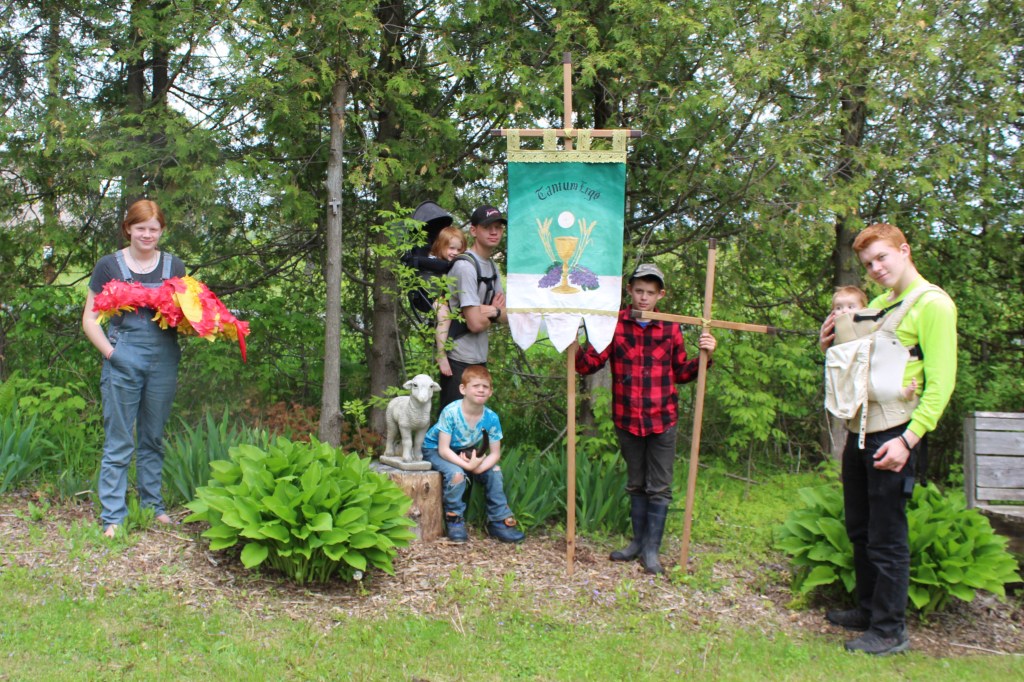
When we set goals for our homesteads, having God asThe Goal and Purpose can help us to offer Him worship and praise throughout the year. Raising pigs with liturgical feasts in mind keeps us grounded in God as we work, and it deepens our appreciation for the work that we do. When we make the Saints a part of our workday, it connects us back to our Maker, recalling us to the mystical Body of Christ. As we go, we will develop traditions that we hope to celebrate each year, but it’s also important that we don’t get so hung up on a particular tradition that we lose sight of the purpose of the tradition. Venison Neck Roast is our traditional St. Nicholas dinner, but if we don’t get a deer hunting, then there is no neck roast. I could get upset about it, stress about it, try to source one from another hunter, but if I’m so focused on it that it’s causing me to lose peace or act in a sinful manner, then the tradition is disrupting my ability to remember the purpose of the meal, and I’ve missed the point entirely.
At an Advent penance service, our priest reminded us that Christmas is a birthday party for our friend. We can buy the nice outfit, go all out on the celebration, get gifts, learn a special song, and make a fancy meal, but if, in the process, we treat our friend poorly, by ignoring them, losing our temper, and being unkind to others too, then we’ve stripped the celebration of the original intention. What friend would be pleased by a celebration meant to honor them if they’d been treated so poorly in the time leading up to the celebration? The celebration would feel like a farce.
Sometimes I don’t enjoy writing about the Catholic traditions I am uncovering or practicing, because it is very difficult to communicate the spiritual (and personal) significance of a tradition. I can write about something like cutting down our own Christmas tree, and as I write, it feels like “Wow, big deal.” Or I write about growing beads for a rosary, and I worry that I’m just giving people something to add to their “to-do” list, and that it won’t be filled with the meaning that it’s supposed to be. And so I write this because tradition is good, as is nostalgia, but they always need to point us back to the greater truth of heaven. If we are so caught up in the past (or even the future), we lose the ability to live well in the present. Tradition is an endeavor to bring us back to a place of nostalgia, and the ultimate place we long to be is heaven.
Any tradition I write about is meant to teach us about God in some way and help us to live more intentionally. Homesteading provides a unique opportunity to live liturgically. Embrace that intention and try to always keep it in mind. You will be cooperating with God to create a nostalgia for your children as well as for family and friends that come to spend time with you. People feel the peace of country living, even when they are unable to live it. They have fond memories of visiting grandma and grandpa on the farm, of baling hay with friends, canning with mom, butchering day with the neighbors, or a good meal and beautiful scenery with friends. It’s why people go to orchards to pick fruit, petting zoos to be around animals, and parks to hike (particularly if they live in the city). Fond memories speak to peace and love!

May you find joy in creating and observing liturgical traditions and memories for your homestead and not only look to the past to a nostalgic view of what farming and life used to be, and bring your family and friends closer to the Lord in the process.
In Christ,
Danielle
 The Liturgical Homestead
Leave a comment