
There are ways in which we can sanctify time alongside fellow Catholics throughout the world, and throughout time. One of the beautiful things about our faith is that many of the things we do and the prayers we say happen not only today in this moment, but in many cases, have happened for centuries and even millennia. When we participate in the Holy sacrifice of the Mass, we don’t just do it now, we do it with all people who have ever lived or who ever will live who have participated. We do it with the saints and angels in Heaven. Though we mark time with these things, we also step outside of time in participating in them.
There are a few ways in which we can sanctify our time in union with others outside of the Liturgy of all liturgy, Holy Mass. The Liturgy of the Hours, also known as the Divine Office, is probably one of the most well-known ways in which we can engage in this union, but the one we’ll look at today is praying the Angelus.
For many Catholics, it is not practical to pray all of the Liturgy of the Hours. Work schedules and needs of our families keep us busy throughout the day, and so maybe we only have time to pray the one of the morning offices or night office (also called Compline). But there is a short and sweet prayer that we can easily incorporate into our day if we only have a few minutes to spare: the Angelus. The Angelus takes less than 5 minutes to pray, and is a simple way to pause our work and turn our attention to God. (While the Angelus is prayed 3 times daily throughout the year, during the Easter season, from Easter Sunday to Pentecost, the Regina Caeli is prayed in its stead.)
The Angelus is traditionally prayed at 6 a.m., noon, and 6 p.m., though you can pray only one of those hours if it is all you are able to do. There is no rule that says you can only pray it at these hours, or that prohibits you from praying it if you catch the clock 15 minutes late. Any time we stop to acknowledge God throughout our day is a good time to do so. The Angelus has even been encouraged to be prayed at dawn, noon, and sunset at different points in history. The tradition appears to have begun with the praying of three Hail Mary’s at the sound of the Compline bell, but the custom of dawn, noon, and sunset are to remind us of Christ’s resurrection at dawn, his suffering before his death at noon, and the annunciation for sunset.
The painting “The Angelus” by Jean Millet shows a man and a woman harvesting potatoes pausing to pray to God at the sound of the church bells in the distance. How many of us take a few minutes to stop our work and simply rest in the mysteries of our Lord?
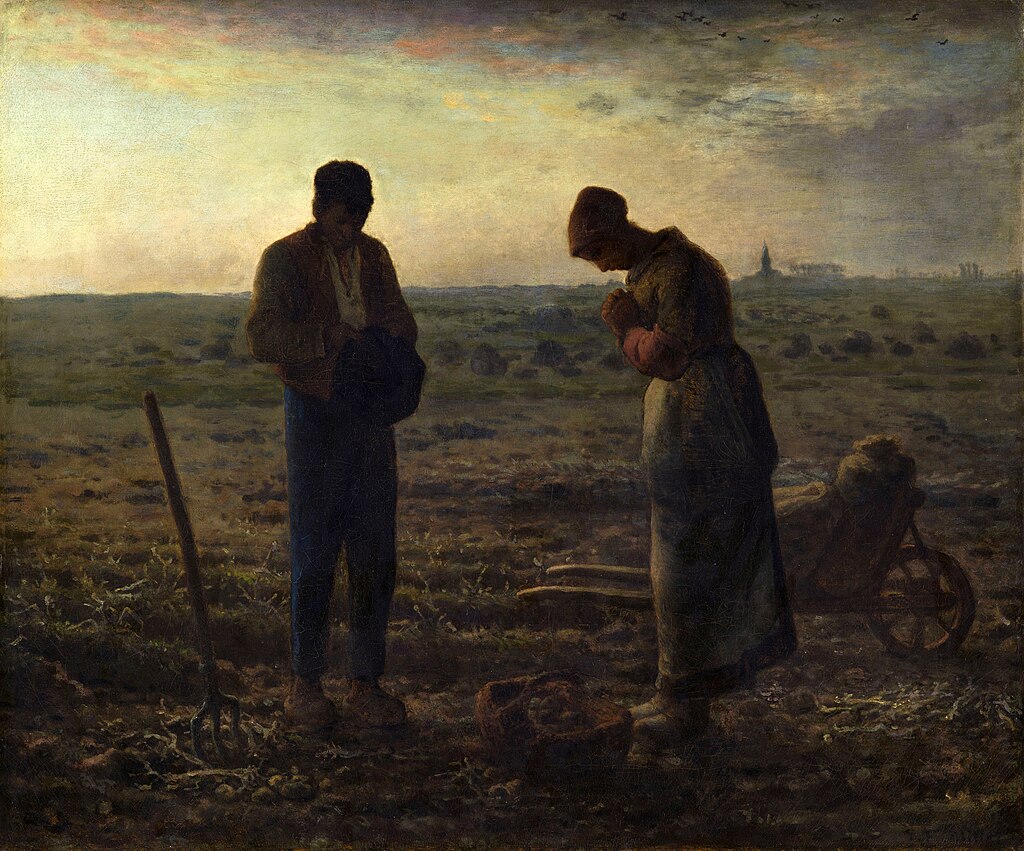
My own family began to pray the Angelus early this year, though I admit, as of late, we haven’t been great about praying it. We do when we think of it, but though our parish church is less than 2 miles away as the crow flies, we rarely hear the church bells here. On a calm day, or when the wind blows from the south, we might catch the ringing, but not often. It’s easiest to hear in the winter when the leaves are off the trees and sound travels farther. We most often catch the noon timing these days. During the school year, it is easier for us to pray all three, but during the summer months, it is more difficult as I have no alarm system at the moment to remind me of these hours. (At the moment, I am without a cell phone. I will likely be getting one again within the next few months, and if I do, I will have an Angelus reminder on it.)
In order to give a “call to prayer” we purchased a so-called “monastery bell” from a fellow Catholic who was downsizing her home. We also have a large cast-iron bell that we still need to mount on a pole outdoors both for prayer reminders and to call the kids in for mealtimes.

Though the ringing of the hour is enough of a call to prayer for many, the traditional way of ringing the bell for the Angelus is to ring three sets of three, with a pause between each set. It appears that for a period of time, an Our Father and a Hail Mary set the spacing between each set of 3.
If you wish to purchase a bell for prayer usage in your home, don’t forget to have it blessed by a priest. If you are not able to have a priest bless your bell, you can still say a prayer over the bell and sprinkle it with holy water before you use it. The Catholic Church has a beautiful blessing of bells that could be adapted for use on your home bell.
Though an alarm could certainly be set as a reminder to pray these days, if you have the ability to ring an actual bell to call your family to prayer or to ring for your self, I highly recommend it. There’s something so special about the sound of a bell! There are many “monastery bells” for sale online. Many claim to be rare, but it’s clear that they are not. And you will likely find that there is not necessarily a history of said bell having been in an actual monastery, though it is certainly possible that they have once resided in a monastery or convent.

You can see a bell, similar to our own, hanging on the wall next to the nun. Perhaps it was wrung for the Angelus!
The angel of the Lord declared unto Mary
And she conceived of the Holy Spirit.
Hail Mary….
Behold the handmaid of the Lord,
Be it done unto me according to thy word.
Hail Mary…
And the word was made flesh, (bow or genuflect)
And dwelt among us.
Hail Mary…
Let us pray: Pour fourth, we beseech the, O Lord, thy grace into our hearts, that we to whom the incarnation of Christ, thy Son, was made known by the message of an angel, may by his Passion and Cross, be brought to the glory of His Resurrection. Through the same Christ, Our Lord. Amen.
In Christ,
Danielle
 The Liturgical Homestead
Leave a comment