Rogation Days are penitential days within the Catholic faith that are observed to ask for God’s protection and mercy, and for a good harvest and the protection of land, animal, and people. Varying sources give different dates of origin, but it is an ancient custom that dates back to the early Church. Catholics are actually not the only Christians who observe Rogation Days. They are still observed amongst Anglicans and some Lutherans.
Sometimes called the Major and Minor Litanies, Cross Days, Rogationtide, and Beating the Bounds, Rogation days are not always described as taking place in the same way. There are, however some things that are consistent.
April 25th is the Major Rogation Day, and though the dates change from year to year, the Minor Rogation Days are always observed the Monday, Tuesday, and Wednesday before Ascension Thursday. They are all penitential days, and as such, a time of abstinence from meat. The litany of the saints is always prayed, and ideally, a procession of some sort takes place around the boundaries of a farm or an entire parish, with prayers for good weather and crops, the safety of animals and farmers and protection of buildings said throughout. Various sources list the days as beginning with Mass or ending with Mass, but if you are able to attend liturgy that day, you would be encouraged to do so.
Aspects of these observations that vary include how the procession is done and where. It was once common practice to walk the entire perimeter of the parish and “beat the bounds”. People quiet literally walked the boundary with sticks and beat the marking posts of the parish boundary. Sometimes a younger child was given a “beating”, too, to help them remember the boundaries. This custom still takes place in some places, though it has largely fallen out of practice. At least in more recent history, as people longed to bring back old traditions, processions sometimes happen on the farms or homesteads of interested families.

Historically, these processions may have stopped at specific landmarks, such as a specific tree or a house, or they may have made a shrine at points at which to stop and pray Landmarks that were natural (such as trees) were sometimes replaced by more permanent markers. Items carried in procession range from flowers to dragons, from banners to relics.
Below is a list things people do or have done. Take what works for you and leave what doesn’t! Maybe you won’t have enough time before the next Rogation Day to prepare the things you would like. That’s okay, just do what you are able. Simply saying the prayers and abstaining is enough to observe.
- Prayers and Readings (Catholic Rural Life has a Rogation Day Observation Guide that you can download and print that contains the prayers and readings used on Rogation Days.)
- Singing hymns: Some suggestions- O Jesus Crowned with all Renown, For the Beauty of the Earth, Now the Green Blade Rises,
- Have a procession
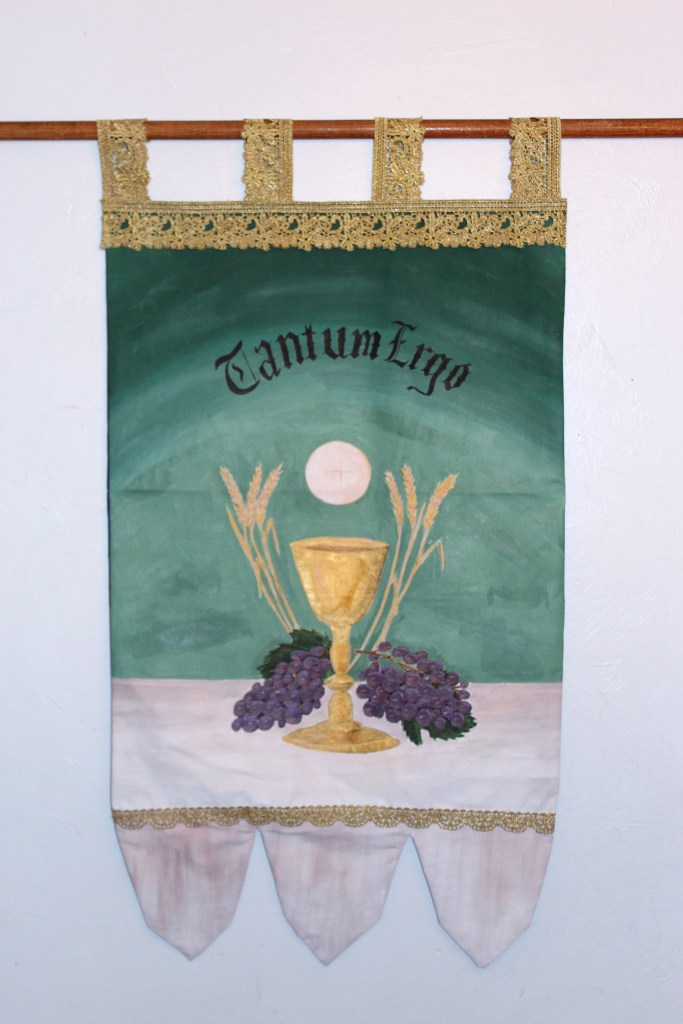
- liturgical banners
- lanterns
- a bier with relic
- bells
- thurible and incense
- holy water and aspergillum (or item to sprinkle the people, places, animals, and things, such as a bundle of leaves)
- processional cross
- flowers and garlands of greens
- dragon* (see note below)
- Abstain from meat on all rogation days
In my research on Rogation processions, there was talk of shrines being installed at the corner posts of a property line where the people would stop and pray. Not too far from the Shrine of Our Lady of Champion near Green Bay, Wisconsin, there is an old Rogation marker shrine still standing.
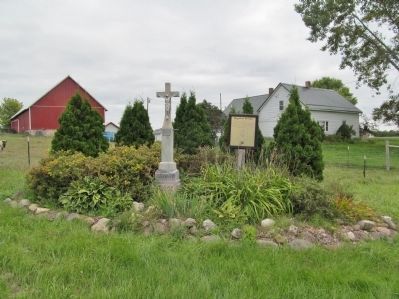
Photo credit K. Linzmeier, September 18, 2014
The dragon for the procession comes from the medieval time period and is not currently in practice that I could find. This would have been used for the Minor Rogation Days as far as I can tell. The dragon is said to represent Satan and the influential power he has had over the world. The dragon leads the procession for the first two days, and it’s tail is puffed up. On the third day, the dragon follows at the end of the procession with its tail hanging down, symbolizing Christ’s victory. We still continue to be tempted to sin, which is why the dragon continues to follow. When the processions would take place, I have read that the dragon would have been placed out of site at the shrines or places of prayer, and then picked up again when the procession would continue, showing that Satan has no right over what belongs to God. On the third day, after the processions have ended, apparently the dragon was sometimes trampled by the people who participated to signify the death of sin.
Some of the processions also had a banner of a lion. The lion would follow the dragon on the first two days and then lead on the third day, the lion symbolizing Christ. These traditions are powerful reminders that we are so often led astray, that we do not deserve God’s mercy, and yet He gives it to us. He frees us from a life of sin, from darkness and damnation. I think that trampling the dragon is also a vivid way of reminding ourselves that we can choose to reject sin. We can turn away from what is evil, from sin that seems to have a grip on us, because God always conquers.
In my research into Rogation Days and their traditions, I received the information below from a priest who served our local area, including the picture. He said there were three primary prayers that went with this tradition:

1) to ask for God’s blessing upon the WEATHER that Spring: for the right amount of rain from the sky and moisture in the earth, and for the right amount of sunlight to bring the crops to full growth.
2) to ask God’s blessing upon the LAND: that the soil might bring the best nutrients to each crop so that it might grow to its full potential and produce an abundant crop for harvesting in the Fall.
3) to ask God’s blessing upon THIS FAMILY and other WORKERS who till this land and plant each crop: for their safety and health in this season, for their cooperation and full labor so that they can bring the best crop they can to nourish their people with plenty.
It was very popular blessing among farm families back then. There was hardly a Catholic family that wouldn’t make sure one of their priests stopped by and ask God for this blessing.”
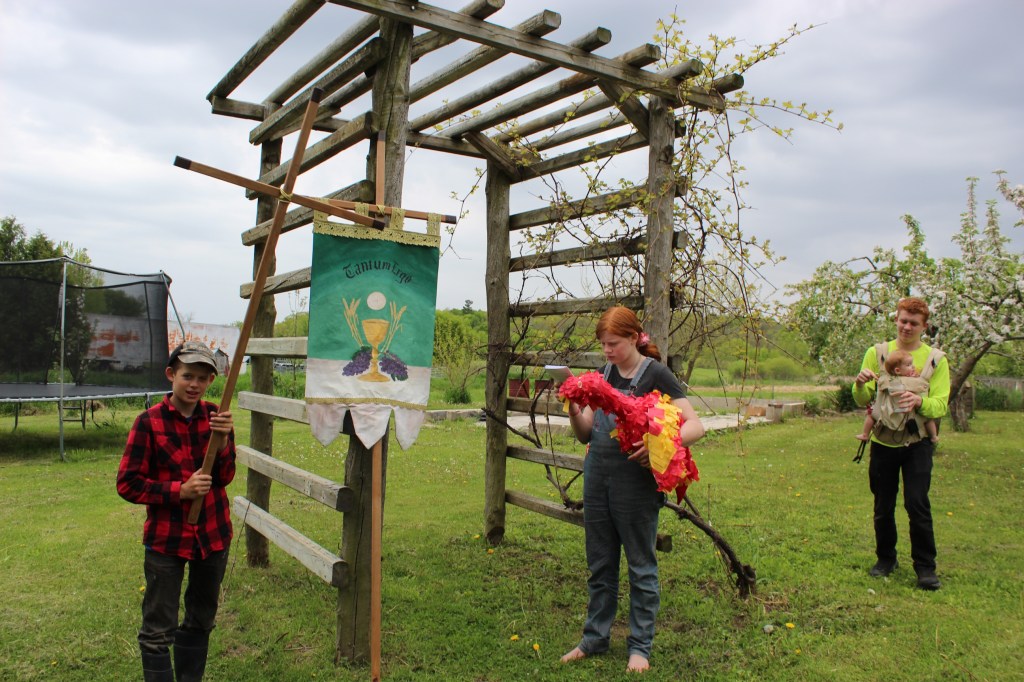
Our very first time observing a Rogation day was for the Major Litany (or Rogation Day) on April 25th of 2025. We scrambled a bit to pull things together as we hadn’t planned far enough in advance, but we had about a month to prepare for the Minor days, and so we made banners, a dragon, and a bier for our relic. My husband had many relatives that were Religious, and one was a godmother to his grandfather. The relic is of St. Alphonsus Ligouri, whom his grandfather was named for. The idea of carrying a relic in procession is that we have a piece of a saint (or something that belonged to them) that can literally process with us. We carry the saints with us in our hearts and prayers, but with a relic, they are present in a totally different way. What a great reminder that we are all pilgrims on this journey!


 The Liturgical Homestead
Leave a comment