There is frustratingly little information out there for how to grow wheat on a relatively small scale. By small scale, I mean an area larger than about 15’x15′. I decided I wanted to experiment with growing wheat because it’s a multi-purpose crop. We’d get fresh grains for milling our own flour, we can feed some to the animals, and the straw can be used for mulch in the gardens or animal bedding.
Disclaimer: I’m not one to do generally do extensive research on how exactly to do something and all the science behind it before I do it. I do it and learn along the way (or after the fact). While this may not seem like the best method, and likely causes me to take longer in having good results, I continue to do this with most things because I gain first-hand experience with why we do something. I see the results of various factors first-hand. I’m also stubborn.
I will tell you right off the bat, I’ve faced a lot of struggles in trying to figure this out. The first year, I couldn’t find any good information at all, and I really did look. The best info I got talked about planting the wheat in rows for a small patch. I only had about 5 lbs. of wheat to plant that year, so I figured that made sense. It didn’t. I don’t know why anyone would plant wheat in rows. It was a bad idea. I did a bunch more research and found a better method. Scatter seed heavily. I used a hand crank seeder and planted a winter crop. That patch did pretty well. I forget how much I planted, but it was probably 15-20 lbs. Some of the area had been worked a lot the year prior, and so that portion of the crop did very well. The big struggle was figuring out how to harvest it. I only harvested a portion of it because I just couldn’t figure out how I’d do it.


Last summer, I had a decent stand of wheat that I was hoping to harvest, but I was absolutely exhausted after baby girl was born.(It was also a winter wheat planted the previous fall.) I looked out the back window one day, and saw a few fauns running through the area and thought, “Uh-oh. Hopefully, they don’t eat it all before I can harvest it.” They mostly stuck to the perimeter, and I had hopes of getting most of the harvest in. The next day, as I dragged my tired self up the stairs to put the baby to bed, I noticed a sandhill crane swoop in and land right in the center of the wheat patch. I threw in the towel. I was too tired to bother trying at that point.
Well, this year I can’t say I’ve done a lot better. I planted a much larger area of spring wheat, probably close to 30’x50′. I committed to learn how to sharpen blades so I could use the scythe. I had problems from the start. I should have tilled the area in the fall to help clean the soil. I tilled in the spring, and I did till a few times before-hand to help kill of the weeds. Immediately after planting, a bunch of blackbirds came in and picked a lot of seed out of one area, but things started to grow. Then one of the kids drove a dirtbike through the field and did a donut in it. It was going to be okay, and I just reminded them not to drive where we’ve tilled or planted.
I noticed that the area where the birds went through was not coming up as thick as some of the other areas, but it was still coming up. And then the weeds started to grow. We’ve got a lot of thistle, and this really took off on the east end of the patch. No big deal, the rest was looking decent. Some weeds, yes, but it would be okay. Meanwhile, I wasn’t getting time to practice sharpening blades…
And then I went out one day near the end of July to check on the crop and I noticed it looked like somebody walked on the edge of the plot. As I got closer and looked around more, I realized that it wasn’t someone, but something. Deer. More than one, by the looks of it. Mind you, we had a dog until Jan. of ’24. She barked at EVERYTHING, and we never had any issues with deer or other animals eating the food we grow. Dog gone, all the wildlife has returned. I sometimes question having re-homed the dog…
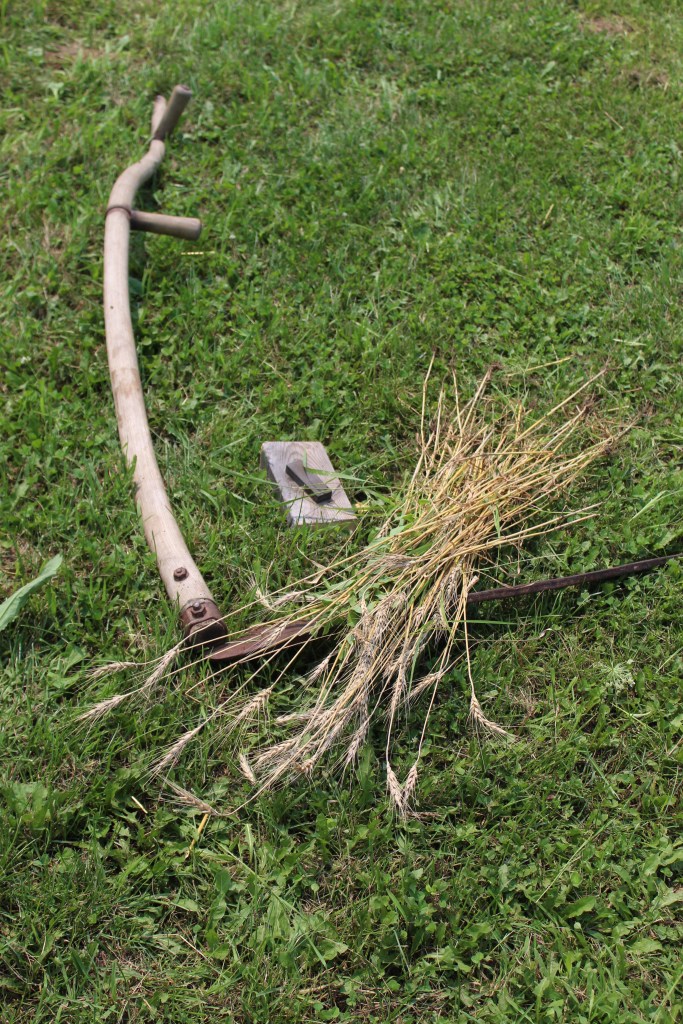
Okay, deer were beginning to get into the wheat. Not great, but it wasn’t quite ready for harvest, either. And we had a lot on our schedule the next couple of days. It’d have to wait ’til Wednesday. I waited, and the deer did more damage. Not surprising, but of course, they went to the portions of the plot that were doing the best and would have been easiest for me to harvest. I spent the morning attempting to sharpen the scythe. It’s an old scythe. I should probably consider buying something new, but they’re expensive. Sharpening is free, if I can figure it out. I made progress on the blade, but every attempt to cut with it was a disappointment.
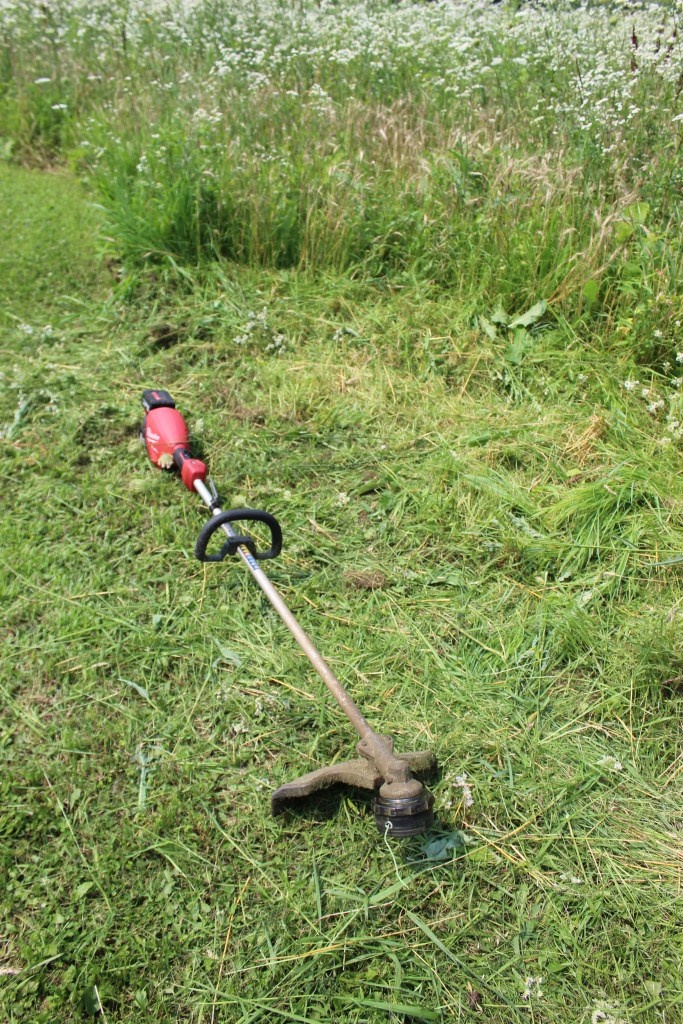
Time for “Plan B.” I wanted to at least harvest some wheat for “Lammas Day” (Loaf Mass Day) so I could make a loaf of bread. The rest could wait just a little longer, I hoped. I decided to try using the weedwhacker. Not ideal. You can only make one pass with it at a time, from left to right. One pass, because any more than that, and you’ll get the straw wrapped up in the head of the trimmer and knock the seed heads around, which shakes out the seed. Left to right because of the direction the string spins. If you go the other direction, it also grabs the wheat and spins it around. The goal is to have it fall flat. If you would happen to be crazy and try to harvest wheat this way, just think of it like using a scythe. You’d swipe and gather, swipe and gather.
Okay, so I figured out this slow but effective method for cutting a larger area. It was just… not the right way to do it. But I gathered enough to fill a wheelbarrow, and that was good enough. Now, to threshing. I tried threshing when I had my semi-decent harvest a couple of years ago, but it was a miserable experience because I didn’t have a good set-up. Guess what I didn’t do in those 2 years? Figure out a good set-up. Instead, I ended up grabbing handfuls of wheat and cutting off the heads. I threw it all into a metal bushel basket and began breaking it down by stomping on it to release seeds. It was a start. Then I put it into a flour-sack towel (the last time I had done it, I used an old pillowcase, but didn’t like how that worked), and beat it with a rolling pin. This was pretty effective. I stopped and rubbed handfuls of seed heads in my hands to help break them down, and then put them back into the towel and rolled with the rolling pin. Not too hard, because I knew it wasn’t fully dry (which is also why the threshing was a little more difficult).
Once we made enough progress, we then did the pour method for winnowing: Pour everything from one bowl to another with a fan blowing to remove the chaff. That was effective. You have to do it a few times, and you still might need to pick some things out, but you should have pretty good results.


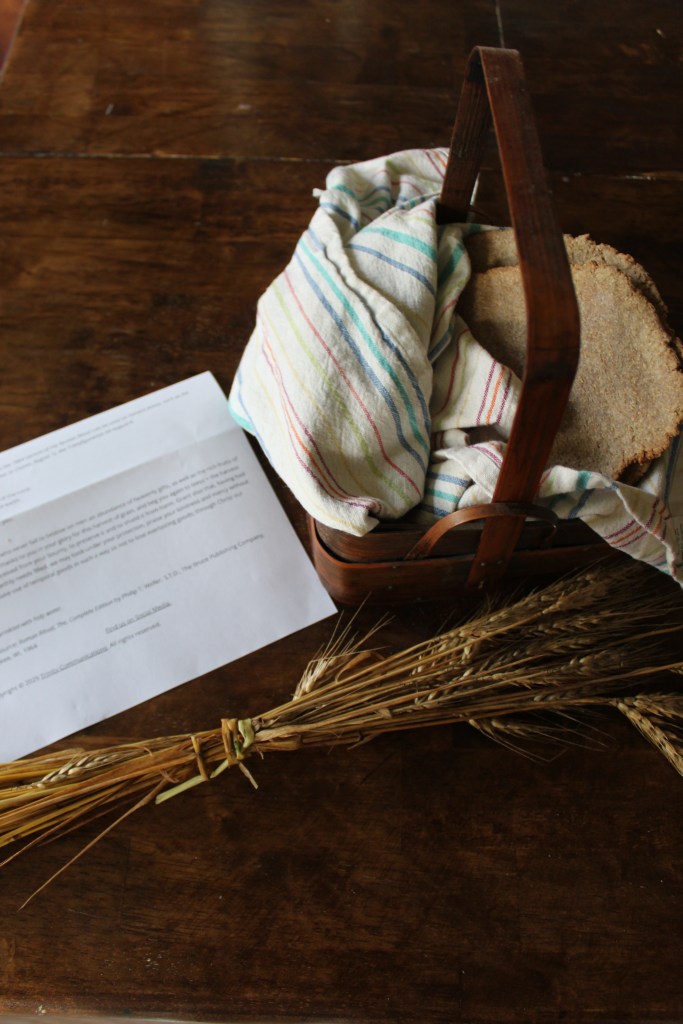
Since my seed wasn’t fully dry, I had to roast it slightly so it could be ground to meet my deadline. 250F for 10 minutes did the trick. Normally, I wouldn’t do that, but I did what I needed to do. Flour ground, we then made a batch of unleavened bread dough, which was divided into three balls to make 3 smaller loaves. At the end of it all, we were able to bring bread to Mass on Lammas Day for blessing, along with a small bundle of wheat. But I still had the remainder of the wheat to deal with…
I tried sharpening the scythe more, but still no success. It’s an old blade, so I’m sure I just need to keep working it. But if I didn’t do something, I’d get no more wheat. So out to the field I went with our older daughter, and we spent a sweaty bit of time trying to grab handfuls of wheat heads to cut from the straw as it stands in the field. We were able to fill a wheelbarrow, though this is significantly more wheat than the first time, because we weren’t gathering the straw, either. I still have to thresh it. I am thinking about going back and watching the episode of “The Chosen” from season 4 where they are threshing wheat to see what kind of set-up they used.
“Okay, fine,” you say, “But what did you learn?” Well, glad you asked. I learned a lot (though not necessarily in the order listed.) First, get the tools you need for harvest before you plant. Have them and be ready, otherwise the day will catch you off-guard. Second, wheat can stand in shocks in the field to dry fully, so you don’t have to wait to harvest it until it’s fully dry, but you will still need to protect it from critters, and you will still need to have a way to actually harvest it. Third, (which was probably the first lesson I learned), plant intensively. Seriously. Plant intensively!!! Wheat is a grass. Think of it somewhat like planting grass seed.
I found two books that were recommended for learning about growing wheat, but I ended up purchasing the book “Small Scale Grain Raising.” It was helpful, I learned a lot. He says to scatter the seed from three directions to give the best coverage. I did that, but I’d maybe even go over it a fourth or fifth time. That would help account for birds and it will give a thick stand of wheat, which I suspect will make the wheat harvest easier.
The second year I planted wheat, I planted an area that had been cultivated the year before. Half of the cultivated area had been planted with potatoes the year prior, and the rest hadn’t been planted. The potato half did really well. Few weeds, taller wheat, bigger heads of grain. Turns out, wheat and potatoes are good to put into rotation with each other, as is corn. Last year, I planted where potatoes had been, and the wheat did really well. The weeds were nearly all thistle, and thistle is just a bugger to get rid of. If you need to get rid of thistle, pigs are a good animal to put on the land to clean it up. Thistle can propagate through rhizomes, and pigs do a good job of clearing that all out. They won’t touch milkweed or burdock, but they will clear out thistle.
As I was doing research for the book this year, I was asking around for different Catholic agricultural traditions, and our missionary priest from India informed me that in his home state, they will bless crosses to put in the field to protect the crops from deer. He didn’t give me further information, and I couldn’t find any more information initially. Just recently, I found out that the blessing of crosses to put in the field happens on May 3rd in commemoration of the Finding of the Cross. I’m guessing that this is the same tradition our priest had. I could still have a cross blessed to be put in the field for the protection of our crops (and may need to… the deer are definitely a major problem this year).
Other things to note… I’m sensitive to straw, so I need to take some sort of allergy medication or preventative before I work with the harvest, and I definitely need to shower afterwards. The heads of wheat are kind of prickly. The little stringy-spike things (called “awn”) are stiff and will scratch you. If you are doing this by hand, you might want to wear long sleeves. Freshly ground wheat from freshly harvested wheat has an unrivaled flavor!
So, what will I do differently going forward? I’m debating whether to buy some old equipment for the small tractors for cutting and threshing, or whether to buy a new scythe and just maintain a good edge. This is really a question of how much wheat I want to grow in the future and how much time I’m willing to spend doing things by hand. I’ll plant more intensively. Whether I plant spring or winter wheat, I will be sure to plant where the soil has been tilled multiple times and cultivated.
If you’ve ever done this before, feel free to leave a comment and give me your pro-tips. I’m listening!
In Christ,
Danielle
 The Liturgical Homestead
Leave a comment